

Runway Says GWM Worlds 2 Trains AI Agents. The Evidence Is One Robot and Two Flags.
GWM Worlds 2 streams real-time 720p worlds with synced audio and pitches itself as agent-training infrastructure. The actual training evidence is one demo.
Runway's demo for the "agent training" half of GWM Worlds 2 is a scene with a humanoid robot standing between a red flag and a blue flag. The robot can move in exactly four directions: forward, backward, left, right. An agent is told to walk to the red flag, then the blue one. It does. Runway's own writeup reports the result in one sentence: it succeeded on its first try, in both cases. That is, as far as the public record goes, the entire evidentiary basis for the claim that just went out to the press: that this is "a simulated environment for evaluations of agents, and for training them in diverse environments."
I want to be precise about what that claim is actually resting on, because the rest of the release is genuinely interesting on its own terms and doesn't need the inflation. GWM Worlds 2, which Runway put out on September 3, 2026, streams continuous, playable 720p video at 24 frames per second with synchronized 48,000 Hz audio, no fixed clip length, responding to text and camera input as you go. That part is real, demoed at length, and worth sitting with. The agent-training pitch layered on top of it, the part that's supposed to justify calling this a "General World Model" instead of just a better real-time video generator, is currently a single anecdote involving four possible movements and two flags.
What GWM actually stands for, and why the name keeps recurring
GWM is General World Models, a research program Runway first laid out on December 11, 2023, arguing that language models trained on internet text were hitting a ceiling and that "the next major advancement in AI will come from systems that understand the visual world and its dynamics." At the time it was a thesis statement with no product attached, a promise that Runway, then known almost entirely for Gen-2 and Gen-3 as creative video-generation tools, was going to spend serious research effort on systems that could model environments and physics, not just render pretty clips.
That thesis took exactly two years to become a shipping model. GWM-1 launched on December 11, 2025, built on Runway's Gen-4.5 video architecture and split into three variants: GWM Worlds, for real-time explorable environments at 720p and 24fps with roughly a two-minute ceiling on coherent generation; GWM Robotics, a synthetic-data and policy-evaluation tool aimed squarely at enterprise robotics teams; and GWM Avatars, for conversational, audio-driven characters. GWM Worlds 2 is the sequel to the first of those three, and the interval between them tells its own story: two years from thesis to product, then under nine months from GWM-1 to its first major sequel. Runway shipped GWM Worlds 2 two days after World Labs, Fei-Fei Li's startup, put out its own Atlas world model in early access on September 1. That's not a coincidence worth reading too much into on its own, but it is a useful marker of how compressed this field's release cadence has become in a single year.
The actual upgrade: audio, unlimited sessions, and a real prompt format
Set the agent-training claim aside for a moment, because the version-to-version engineering is legible and worth explaining on its own. GWM-1's Worlds variant was silent and capped at roughly two minutes before coherence broke down. GWM Worlds 2 adds native, synchronized 48kHz audio generated alongside the video in the same stream, and removes the fixed session length entirely: "the world continues from each new input instead of following a fixed clip or script, so sessions have no preset length," per Runway's own writeup. Under the hood, it's an autoregressive diffusion model with a sliding key-value cache over past frames and causal video/audio decoders, the same general recipe as most real-time video-generation systems this year, adapted here to also decode sound frame-by-frame rather than as a separate pass.
The more interesting design choice is what Runway calls WorldPrompt, a two-layer scene format that splits persistent facts about a world from the events happening inside it. The persistent layer, the "genesis prompt," describes environment, layout, materials, lighting, ambient sound, the subjects that can act, and the "laws" governing them, from gravity and collision to what a given character is allowed to do. Layered on top is a timestamped event stream: free-form text actions, each addressed to a specific subject or to the scene itself, with start and end timestamps, plus a separate per-frame camera-motion track. Multiple actions can overlap in time, which is how Runway gets a player, an NPC, and an independently steered camera all acting inside the same continuous generation.
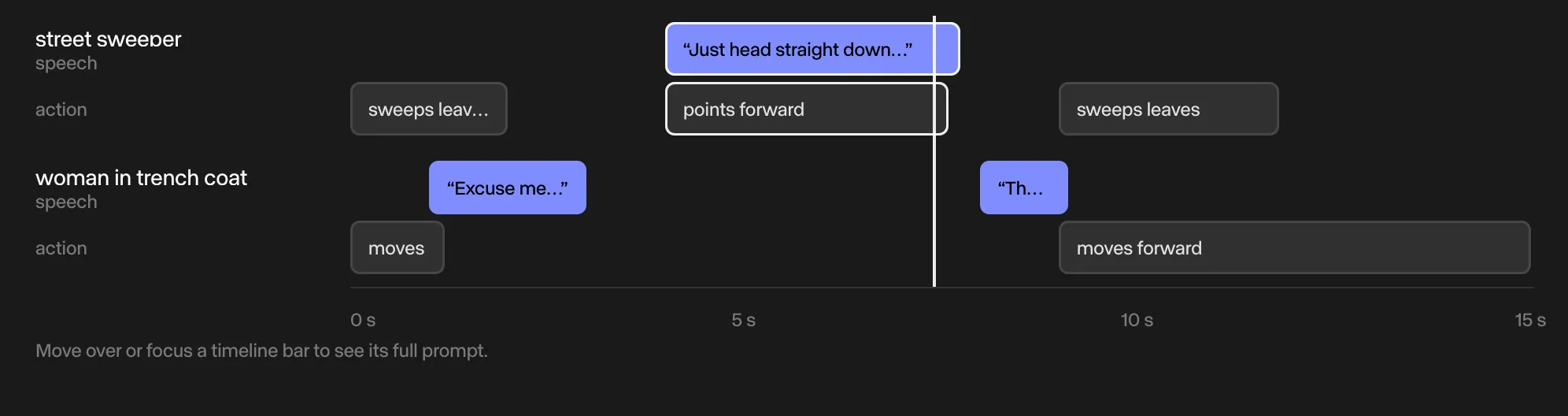
Runway ships this in three operating modes, and the framing is candid about which one actually works well today. "Ahead of time" lets a user (or an LLM) write the entire event stream up front, then renders the whole thing at once; Runway says this is the mode that currently produces the best quality, because the text prompts can pack in far more detail than something typed on the fly. "Turn-based" pauses generation at decision points, which is closer to a visual novel or an interactive-fiction engine. "Real-time" is the hard one: continuous generation with actions that have to land with low latency and immediately bend the stream, which is what the public demo (a mage exploring a snowy pass, with keys and mouse clicks bound to premade action prompts like "the character throws a ball") actually runs. Runway's own limitations section admits the gap plainly: the real-time, autoregressive version trades fidelity for speed, degrades on quick camera rotations, and has "imperfect" long-term memory, exactly the failure mode you'd expect from a model that's still fundamentally predicting the next frame from recent visual context rather than tracking explicit state.
That last point matters more than it might sound. Code World Model [check_internal_link], a research release out of Westlake University's AGI Lab that landed a week before GWM Worlds 2, built its entire architecture around the argument that a video-only world model can never reliably remember anything, because there's no ledger anywhere in the system, only whatever visual residue survives in the model's own recent output. CWM's answer was to hand state-tracking to an actual coding agent running deterministic code, and let a video model handle only rendering. GWM Worlds 2 doesn't do anything like that. It's a pure video-and-audio autoregressive model with a sliding attention window over recent frames, which is precisely the design CWM's authors were arguing against, and Runway's own limitations section, in different words, confirms the same failure mode CWM was built to route around.
The agent-training pitch, examined closely
Here's the section of the release that's doing the most strategic work and the least evidentiary work. Runway's writeup includes an "Agentic Control" section demonstrating that an LLM-driven agent can steer both a character's actions (move, attack) and the environment (lighting) inside a live GWM Worlds 2 stream. Then comes the sentence carrying the whole business pivot: "GWM Worlds 2 can be used as a simulated environment for evaluations of agents, and for training them in diverse environments." The supporting evidence for that sentence is the red flag and blue flag test I opened with: a robot restricted to four discrete movements, told to reach one flag, then the other, succeeding both times, on the first attempt, with no reported failure runs, no success-rate statistic across repeated trials, and no comparison against any other environment.
That's not nothing, generating a coherent world an agent can act inside at all is a real engineering achievement, but it's a proof of concept, not a benchmark, and readers should treat the framing accordingly. What makes the gap easy to miss is that Runway does have a legitimately rigorous piece of work in roughly this space, it's just not this model. In February 2026, Runway's robotics team published a separate study, "Accelerating Robot Policy Evaluation with General World Models," that ran eight real vision-language-action robot policies (models that map camera input and language instructions directly to robot actions) through both real-world testing on a Franka Emika Panda arm and simulated rollouts inside GWM-Robotics, the sibling variant built for exactly this. Across roughly 1,450 simulated rollouts and more than 16,000 individual human ratings, the simulated success rates correlated with real-world outcomes at a Pearson coefficient of 0.95, and on the subset of policies also covered by an external framework called PolaRiS, the correlation hit 0.986 with a mean maximum rank violation of zero, meaning the simulation ranked every policy in exactly the order the real robot did.
Runway world-model research | What it actually measured | Headline number |
|---|---|---|
GWM Worlds 2 agent demo (Sept 2026) | One robot, four movement directions, two flags, one attempt each | Qualitative success, no statistics reported |
Robot Policy Evaluation study (Feb 2026, GWM-Robotics) | 8 real VLA policies, ~1,450 simulated rollouts vs. real Franka Panda arm results | Pearson correlation 0.95; 0.986 on the PolaRiS-matched subset |
That correlation study is genuinely substantive, self-published but methodologically real, with a large rollout count and independent human grading. It's also, importantly, evidence for a narrower and different claim than the one GWM Worlds 2's press cycle is riding on. It shows a world model can rank already-trained robot policies against each other with high fidelity to real-world results, which is a real and useful thing for a robotics team deciding which policy to deploy. It does not show that an agent was trained from scratch inside the environment, and it was run on GWM-Robotics, a model built and evaluated specifically for tabletop manipulation with one robot arm, not on GWM Worlds 2, the general-purpose, audio-enabled, multiplayer environment announced this month. Citing one as proof of the other's capability, which the framing around GWM Worlds 2 invites a reader to do, is exactly the kind of gap between a company's own numbers and its own claims worth flagging plainly rather than letting slide.
There's a second layer worth being clear-eyed about, too: even the rigorous study evaluates a world model standing in for a real robot's real physics, verified by comparing outcomes to a Franka arm actually doing the task. GWM Worlds 2 has no physics engine underneath it at all. Its "laws" (gravity, collision, character abilities) are text descriptions inside a genesis prompt, honored only to the extent the diffusion model learned to honor similar descriptions during training. That's a fundamentally different guarantee than MetaMotivo [check_internal_link], Meta FAIR's zero-shot humanoid-control model, which runs its simulated body inside MuJoCo, an actual physics engine computing real joint torques and collisions at 450Hz, with the neural network only choosing what to do inside those verified dynamics. Training or evaluating an agent inside GWM Worlds 2 means training it against a video model's implicit, unverified prior about how gravity and collision look, not against dynamics anyone has checked are consistent from one run to the next. That's the actual technical distance between "a video generator that can render a robot" and "a simulated environment for training AI agents," and it's a distance the current release doesn't close.
Where GWM Worlds 2 sits in a suddenly crowded field
This wouldn't be a story worth writing if Runway's competitors weren't making structurally similar claims with their own asterisks attached. Google DeepMind's Genie 3 holds interactive 720p environments together at 24fps for "several minutes," an improvement over Genie 2's roughly ten-second ceiling, but remains a closed research preview with documented physics glitches and no public release date, so there's no way to run it against GWM Worlds 2 directly. World Labs' Atlas, announced two days before GWM Worlds 2 with $1.23 billion behind it, takes an architecturally different route: it's 3D-native, anchoring every input to an actual position in space and outputting real point clouds or Gaussian splats rather than a video stream, which means an Atlas-reconstructed room is something you can genuinely measure and drop a robot into, at the cost of a much narrower creative range than a pure video model offers. NVIDIA Cosmos, the incumbent robotics-focused option, skips the creative-tool framing entirely and positions itself from the outset as infrastructure for policy learning and synthetic sensor data. NVIDIA, notably, is also a strategic investor in Runway's most recent funding round, which makes it simultaneously a competitor to GWM Robotics and a backer of the company building it, a detail that says something about how unsettled this market still is.
System | Maker | State grounding | Resolution / fps | Audio | Access |
|---|---|---|---|---|---|
GWM Worlds 2 | Runway | Video-model implicit priors only | 720p / 24fps | Native 48kHz | Research preview, waitlist |
Genie 3 | Google DeepMind | Video-model implicit priors only | 720p / 24fps | Not disclosed | Closed research preview |
Atlas | World Labs | Native 3D geometry (point clouds, Gaussian splats) | Up to 1440p | Not primary focus | Early access, select partners |
Cosmos | NVIDIA | Purpose-built for physics/policy learning | Varies by model | Not primary focus | Open framework, developer access |
Code World Model | Westlake AGI Lab / NTU | Explicit code-tracked world state | Renderer-dependent | Not disclosed | Code and weights released |
Runway's own $315 million Series E, closed in February 2026 at a $5.3 billion valuation with General Atlantic leading and NVIDIA participating, was explicitly earmarked for scaling this exact three-branch GWM strategy, per the company's own statement that it's building systems meant to "understand and simulate the world," not just generate clips. That's a real strategic bet, and not a cheap one: co-CEO Anastasis Germanidis has framed world models as scientific infrastructure for drug discovery and climate modeling, well beyond gaming or film, while independent observers have pushed back hard on the jump. Stanford lecturer Kian Katanforoosh told TechCrunch bluntly that "no one has yet proven the jump between video intelligence" and the kind of general reasoning world models are pitched as delivering, and pointed to OpenAI's shuttering of Sora, reportedly burning roughly a million dollars a day against thin revenue, as a reminder that compute-heavy generative video bets don't automatically become sustainable businesses just because the demos look good. A separate analysis of Runway's robotics ambitions specifically calls out the "lab-to-floor gap": a model that improves sample efficiency in a research setting can still fail to matter on an actual factory floor if it doesn't meet the tight latency budgets and reliability bar real control loops demand, and argues that a credible win here will look like narrow, measurable improvements in specific deployments rather than a single dramatic robotics breakthrough.
None of that makes GWM Worlds 2 uninteresting. The real-time, dual-audio, unlimited-session streaming is a legitimate technical step past GWM-1, and the WorldPrompt format is a more thoughtfully composable action interface than most competitors have shown publicly. But the specific claim carrying this release into robotics and agent-training conversations, that this is meaningfully "a simulated environment for evaluations of agents, and for training them," is currently supported by one robot finding one flag, sitting next to a genuinely rigorous but separate study of a different model evaluating already-trained policies rather than training new ones. Runway has, elsewhere, shown it can do the harder, more boring work of running real robots against real ground truth and reporting honest correlation numbers. It just hasn't done that yet for the model it's putting that claim on this week.