

MetaMotivo Never Rehearsed Standing Up. It Just Knows How.
Meta's MetaMotivo controls a virtual humanoid through hundreds of tasks it was never specifically trained on, no retraining, no planning, just a prompt.
Picture a gray, faceless human body standing alone in an empty void, the kind of placeholder mannequin you'd see in a 3D modeling tutorial before anyone bothers to add skin or clothes. Now knock it over. It gets back up. Not because anyone programmed "getting up" as a behavior, and not because it practiced falling down a few thousand times first. Someone just asked it to, the same way you'd type a sentence into a chatbot, and it stood back up looking approximately like a person would.
That's the pitch behind MetaMotivo, a research release Meta's Fundamental AI Research group (FAIR) put out on December 12, 2024, buried inside a nine-project research dump that also included a video watermarking tool, a new tokenizer scheme, and an update to CLIP. Most of that batch was the kind of infrastructure work that matters enormously to researchers and to approximately nobody else. MetaMotivo was the one with a body in it, and bodies are where research starts looking like something a person can actually watch.
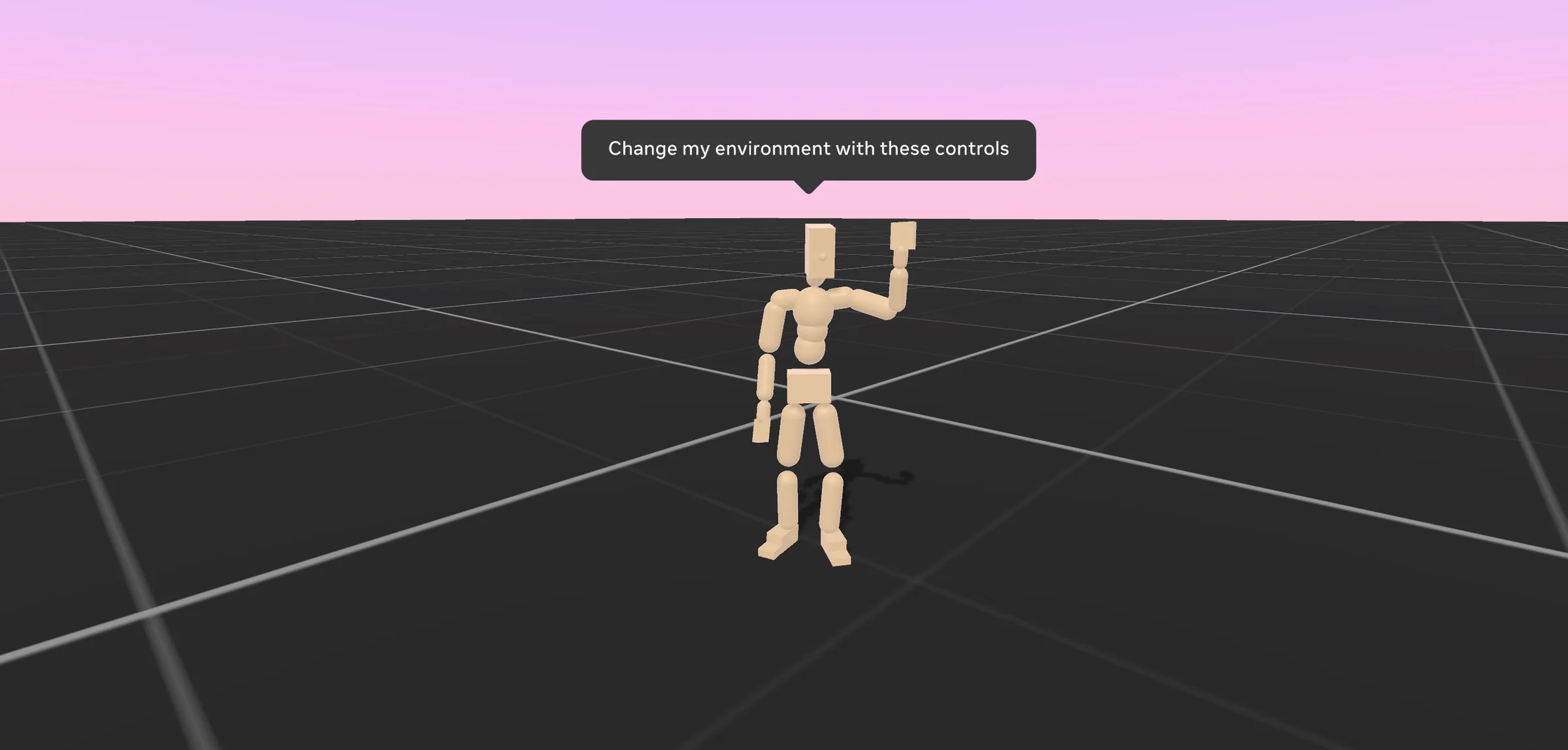
Get the disclaimer out of the way first, because it's the single most common misunderstanding about this project: MetaMotivo does not control a robot. Nothing here touches actual metal, actuators, or a warehouse floor. It's a policy that moves a simulated body inside a physics engine, full stop, which puts it in a different lane entirely from something like the humanoid robots that raced and fell over in Beijing this August [check_internal_link] or Skild AI's S1 [check_internal_link], which is trying to get a physical arm to flip a pancake. MetaMotivo's body only exists as math inside MuJoCo, the physics simulator, wrapped around a skeleton called SMPL (Skinned Multi-Person Linear model), the same 24-joint humanoid rig that shows up constantly in computer-vision and animation research because it's realistic enough to be useful and simple enough to be tractable. If Meta ever points this same approach at a real physical robot chassis, that's a different, much harder paper. This one is about a body that only has to obey physics, not a body that has to obey physics while also draining a battery and not falling on a person.
So what does "zero-shot" actually buy you here. In most of animation and robotics, teaching a character a new skill means collecting demonstrations of that specific skill and training on them, or at minimum fine-tuning on them. MetaMotivo skips that step at test time entirely. You hand it a prompt, which can be a reward function (a formula scoring how well the body is doing at some goal, like "move forward" or "keep your hands above your head"), a single target pose to reach, or a full motion clip to track, and the model converts that prompt into a vector, then acts on it immediately. No gradient updates happen. No retraining loop runs in the background. It's closer to how you'd prompt a language model with a new instruction than how you'd normally teach an embodied agent a new trick, and it's the same broad idea Skild AI chased with its own robot policy about twenty months later, just applied to a body that only has to survive contact with a simulated floor.
The engineering underneath the demo is the more interesting story, and it's not the usual scale-and-pray recipe. The paper behind MetaMotivo, Zero-Shot Whole-Body Humanoid Control via Behavioral Foundation Models, accepted to ICLR 2025, calls the method FB-CPR: forward-backward representations with conditional policy regularization. Strip the jargon and it comes down to this. The model learns two functions that map states and actions into a shared latent space, a "forward" map and a "backward" map, the kind of construction unsupervised reinforcement learning researchers have been refining for a few years specifically because it lets you compute a near-optimal policy for almost any reward function after training, without ever training on that reward function directly. Left alone, that trick tends to produce agents that solve the reward correctly but move like nothing you'd recognize as human, all flailing limbs and physically valid but deeply uncanny motion. FB-CPR's fix is the "CPR" half: a discriminator, trained the way a GAN's discriminator is trained, that constantly nudges the policy to stay close to real human motion capture, regardless of what reward it's currently chasing. The unlabeled motion data doing that nudging comes from AMASS, a widely used mocap archive, filtered down to roughly 9,000 clips (about 29 hours) for training with another 990 clips held out for evaluation. The result is a policy that's rewarded for being effective and separately, continuously penalized for moving in a way no human ever would.
All of that training happens inside HumEnv, a companion environment FAIR built specifically to standardize this kind of research: the SMPL skeleton (24 rigid bodies, 23 of them actuated), simulated in MuJoCo at 450 Hz with the policy issuing new joint targets 30 times a second, and a benchmark suite covering three task families: pure reward optimization, goal-pose reaching, and full motion tracking. Meta released two checkpoint sizes on Hugging Face, five seeds of a 24.5-million-parameter model called MetaMotivo-S and one larger 288-million-parameter MetaMotivo-M, the version actually running behind the public demo. Both the code and weights are genuinely open to download and inspect, which is more than a lot of foundation-model announcements can say, though the license is CC BY-NC 4.0, non-commercial only. A game studio can poke at this all it wants in a research sandbox; shipping it inside an actual product needs a different conversation with Meta first.
Now the part every "zero-shot foundation model" claim eventually has to survive: the actual numbers. And to its credit, this is one of the more legible benchmark stories in recent AI-research coverage, because the comparison points are so, so much easier to define than "does this feel more helpful." A reward-optimization task has a score. A goal is either reached or it isn't. A tracked motion either matches the reference clip closely enough to count as a success or it doesn't. The paper reports MetaMotivo against two kinds of baselines: task-specific "oracle" policies trained from scratch on that exact task with full access to it, which set a realistic ceiling, and other zero-shot or unsupervised methods trying the same trick MetaMotivo is trying.
Method | Training | Avg. reward score | Goal-reaching success | Motion-tracking success |
|---|---|---|---|---|
TD3 (task-specific oracle) | trained on the exact reward | 249.7 | not applicable | not applicable |
PHC (task-specific oracle) | trained on the exact goal/motion | not applicable | 94% | not applicable |
Goal-GAIL | zero-shot | not applicable | 25% | 25% |
ASE | zero-shot | 105.7 | 37% | 40% |
CALM | zero-shot | not applicable | 71% | 73% |
Diffuser | zero-shot | 85.3 | 14% | not applicable |
MetaMotivo (FB-CPR) | zero-shot | 151.7 | 83% | 83% |
Read that table honestly and two things are true at once. MetaMotivo clears every other zero-shot method on every metric where a comparison exists, sometimes by a wide margin (151.7 against Diffuser's 85.3 works out to roughly 178% of it, which lines up with Meta's own "177% of Diffuser" framing). And it lands at somewhere between 61% and 88% of what a specialist model trained on nothing but that one task can do, depending on which task you're measuring. That's a legitimately strong zero-shot result. It is also, by definition, still behind the best narrow model on every single task, which is worth saying plainly instead of letting "outperforms baselines" do the work of implying otherwise. There's a real asterisk hiding in the tracking numbers too: MetaMotivo matches PHC's 83 percent-ish tracking success rate, but its actual positional error on tracked motions (the paper's EMD metric) runs noticeably higher than the task-specific trackers, meaning the moves that do count as "successful" are visibly less precise up close than the failure rate alone suggests.
Meta also ran a human evaluation, which is the honest way to check whether "human-like" is doing real work or just sitting in a press release. Fifty raters compared MetaMotivo's behavior against a reward-only baseline (TD3) with similar quantitative scores, and rated MetaMotivo as more human-like in 83% of reward-based comparisons and 69% of goal-reaching comparisons. In other words, when two policies score about the same on the actual task, people consistently pick the one regularized toward real motion capture as looking more like an actual person, not a robot that happens to satisfy an equation. That's a genuinely useful thing to have measured, and it's the clearest evidence for Meta's framing of this as a step toward "lifelike" virtual agents rather than merely competent ones.
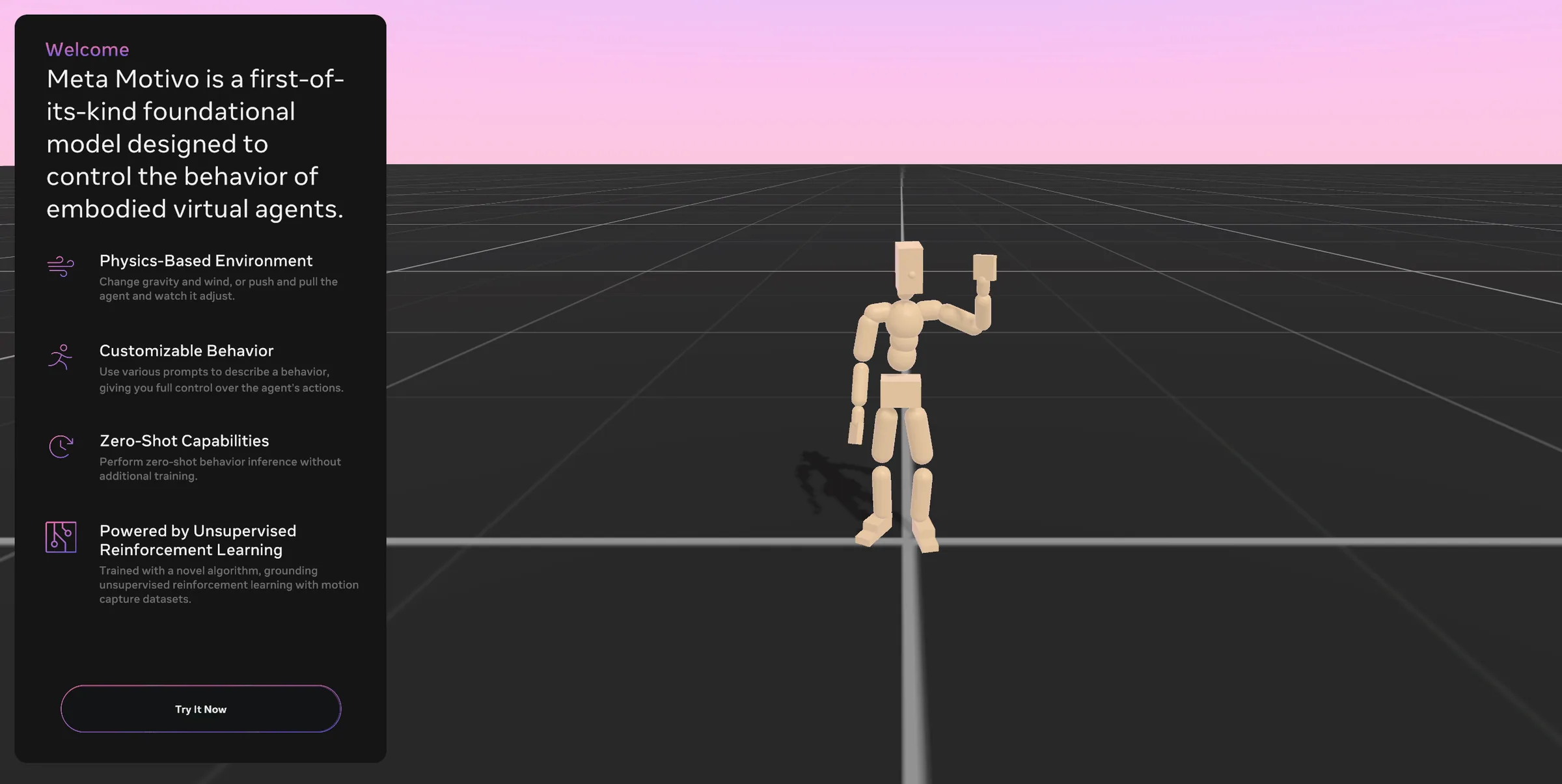
It's worth being clear-eyed about where the model actually struggles, because the same coverage that captured that demo screenshot also flagged the rough edges: MetaMotivo does noticeably worse on anything fast or ground-contact-heavy, sprinting, jumping, rolling, recovering from an actual fall rather than a scripted reset, and it can produce a visible jitter in some sequences where the underlying motion data didn't cover enough of the relevant nuance. None of that is unusual for a model this size trained on 32 hours of mocap. It's exactly the kind of limitation you'd expect from a system whose entire behavioral vocabulary comes from a finite motion capture archive, and it's a useful reality check against the more breathless "just like a real person" framing some of the initial coverage reached for.
The most concrete evidence that MetaMotivo landed as more than a one-week news cycle is a piece of independent research that showed up about a year and a half later. A 2026 paper called Plan, Don't Pose tackles long, multi-step text-to-motion generation, turning a sentence like "walk to the table, then sit down" into a full animated sequence, and it does it by treating MetaMotivo's frozen policy as the actual execution layer. Rather than generating raw poses directly from text (the standard approach, and the one that tends to drift and lose coherence over longer sequences), the authors infer a sequence of MetaMotivo's own latent behavior codes and let its pretrained tracking procedure turn those into motion, keeping MetaMotivo entirely frozen the whole time. That's a meaningfully different kind of citation than a roundup blog linking back to the original announcement. It's someone else's research treating MetaMotivo's latent space as a reusable interface, which is the actual bar for a "foundation model" claim to mean something, not just a scaling number in an abstract.
Zoom out and the honest read is that MetaMotivo is a solid, credibly peer-reviewed piece of unsupervised RL research wearing a demo-friendly costume. Unlike a lot of the foundation-model claims that get thrown around a news cycle at a time, this one actually went through ICLR's review process rather than shipping straight from a company blog to a press release, which counts for something when you're deciding how much to trust the benchmark table. Where it's genuinely useful today is narrower than the "Metaverse NPCs and VR avatars" framing Meta reached for at launch: it's a clean research substrate for anyone studying humanoid control, motion generation, or unsupervised RL, evidenced by the fact that at least one serious follow-up paper is already building directly on top of it. What it hasn't become, almost two years on, is the engine quietly running behind a game's NPCs or a VR platform's avatars, which is a fair distance from where Meta's own launch copy pointed. The gray body in that demo still doesn't know it's supposed to be someone's avatar yet. It just knows, with real robustness, how to fall down and get back up.