

A Robot Outran Usain Bolt in Beijing. It Still Doesn't Know How to Stop.
In Beijing, a robot ran 100 meters faster than Usain Bolt ever has, then crashed into the padding. The record isn't quite what it looks like.
The most honest photograph to come out of Beijing this week isn't the finish line. It's the ten feet just past it, where a two-legged machine that had just run faster than any human in history plowed straight into the crash padding because nobody had gotten around to teaching it how to stop. Fox News noted several robots had exactly this problem after their 100m finals: full sprint, clean line, no plan for what comes after. It's a pretty good metaphor for where humanoid robotics actually is right now. The going is the easy part.
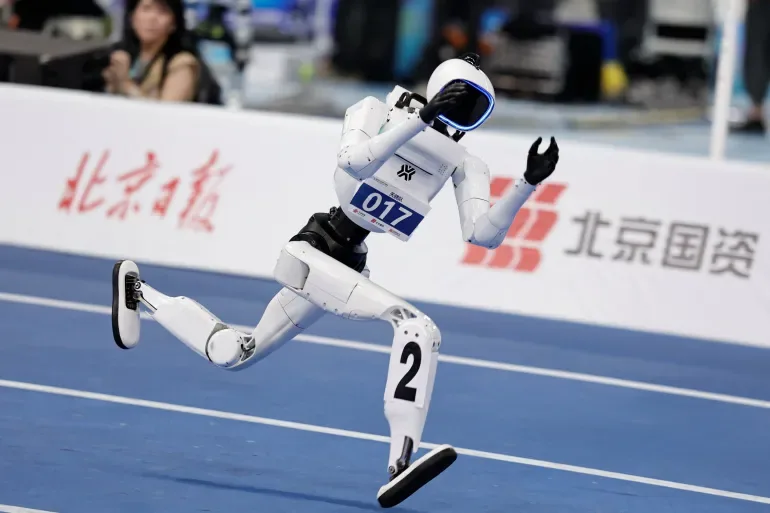
But let's not undersell the sprint, because it's genuinely wild. This past week, the 2nd World Humanoid Robot Games took over Beijing's National Speed Skating Oval, the "Ice Ribbon" left behind by the 2022 Winter Olympics, and turned it into something between a track meet and a robotics conference. More than 600 teams showed up this year, according to Nature's coverage of the event, up from roughly 280 teams and 500 robots at the inaugural Games last year. That jump matters more than any single stopwatch reading, because last year's Games were, by nearly every account, a blooper reel: robots tipping over mid-stride, face-planting off jumps, getting walked off the track by human minders. A year later, several of the results didn't just improve. They cleared marks set by the best human athletes who have ever lived, in events track and field has been measuring for over a century.
Start with the number everyone's already seen: multiple robots at these Games ran the 100m in under 9.58 seconds, which happens to be Usain Bolt's actual world record, set at the 2009 Berlin World Championships and still unbeaten by a human seventeen years later. (You may have seen this reported as "9.38 seconds" somewhere online. That's simply wrong, and it's worth being precise about, because 9.38 would be slower than Bolt's real mark on paper. The comparison only works once you use his correct time.) X-Humanoid's entry, a sprinter called Tiangong Ultra, ran an early heat in 9.39 seconds, already a fifth of a second under Bolt, and kept shaving time off through the week. CGTN, Global Times, and Tech Times all reported its final time as 8.64 seconds, though Al Jazeera separately clocked an earlier round at 8.86. A rival sprinter called Lightning, built by Honor, ran 9.32 in pre-event testing and 9.47 in its official final. However you slice the rounds, the fastest robots in that oval were covering 100 meters nearly a full second quicker than the fastest human being alive has ever managed.
Tiangong Ultra itself isn't the product of a single scrappy startup. It comes out of X-Humanoid, the Beijing Humanoid Robot Innovation Center, a state-backed consortium whose backers include Baidu, Xiaomi's robotics arm, and Beijing municipal capital. This is the same platform that won the Beijing E-Town half marathon last year, and per RoboAtlas's spec sheet, the outfit has already placed nine units with universities and development partners as a research platform. This isn't a lone garage project outrunning Bolt. It's an industrial policy outrunning Bolt, which is arguably the more interesting fact.
And here's the caveat that actually matters, the one that gets lost every time this clip gets reposted with a "world record" caption: Bolt still holds the record that counts. These robots aren't starting from blocks under IAAF false-start rules. They aren't drug tested. And, again, several of them couldn't stop themselves after crossing the line. "Ran the 100m faster than Usain Bolt" is a true sentence about elapsed time. "Broke the world record" is a different sentence, one that no sanctioning body on Earth would sign off on, because the robots aren't competing under the rules that make a world record a world record in the first place. Both things are true simultaneously: the raw speed is real, and the record framing is a headline doing more work than the underlying claim can support.
Event | Robot | Time | Human benchmark |
|---|---|---|---|
100m final | Tiangong Ultra (X-Humanoid) | 8.64s | Usain Bolt, 9.58s (2009 world record) |
100m, earlier round | Tiangong Ultra | 8.86s (Al Jazeera) / 9.39s (early heat) | |
100m final | Lightning (Honor) | 9.47s | |
100m, pre-event testing | Lightning | 9.32s | |
400m final, large-class | Tiangong Ultra | 38.15s | Wayde van Niekerk, 43.03s (2016 world record) |
400m final, small-class | Tiangong Omni | 45.66s |
The 400m produced the week's other genuinely record-breaking run, and also its most memed one, and they came from two different robots that keep getting flattened into one in the retelling. Tiangong Ultra, the same larger platform from the sprint, won the large-class 400m in 38.15 seconds, comfortably inside Wayde van Niekerk's human world record of 43.03 seconds from Rio 2016. A separate, smaller robot called Tiangong Omni won its own small-class 400m in 45.66 seconds, per Ecns.cn, and it's Omni's running form that actually broke the internet: arms tucked tight against its face, torso pitched sharply forward, a posture that earned it nicknames along the lines of "the socially anxious sprinter." CGTN ran a piece specifically shutting down a rumor that Omni had learned this by copying a viral video of a little girl running the same way. Its engineers confirmed the gait was self-developed entirely through reinforcement learning, a training method where the robot isn't shown how to run so much as rewarded, in simulation, every time it stays upright and gets faster, until a strategy emerges on its own. And the strategy it landed on is unglamorous but makes sense once explained: rotating from the hips and waist burns less energy than swinging full human arms, and leaning forward shifts the center of mass in a way that helps balance at speed. Omni didn't learn to run wrong. It learned to run efficiently for a body that isn't shaped like ours, and it looks strange precisely because it stopped trying to look like us.
The jump that got mismeasured, and the correction that makes it more impressive
This is where most of the coverage of these Games, understandably, started tripping over itself, because the jumping events split into two different categories that are easy to mix up if you're not paying close attention: jumps from a dead stop with no run-up, and jumps with a full approach. Getting that distinction right changes the story.
The standing long jump held up fine. Tiangong Ultra improved across the week from an early mark near 4.8 meters to a final Games record of 4.83 meters, a leap (sorry) from just 1.47 meters a year earlier. The human comparison making the rounds is Byron Jones's 3.73 meters at the 2015 NFL Combine, still popularly cited as the benchmark even though it was never ratified by any athletics federation. The standing long jump left the Olympic program after 1912, and the closest thing to an official mark, Norwegian shot-putter Arne Tvervaag's 3.71 meters from 1968, lands almost exactly where Jones's number does anyway. Either way you cite it, Tiangong Ultra cleared it by more than a meter. That comparison is legitimate, event for event.
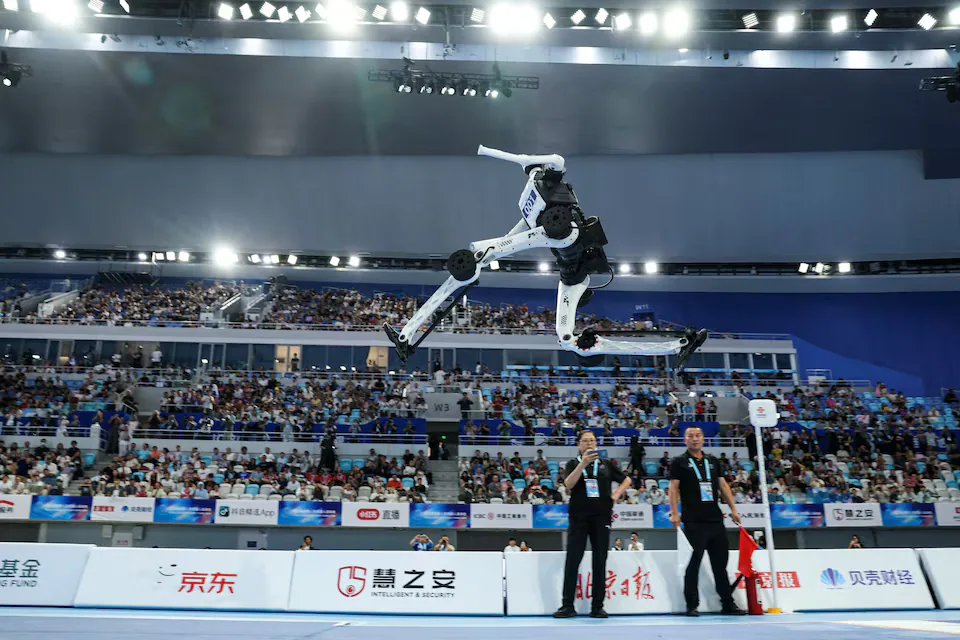
The standing high jump is where things actually went sideways, and it's worth slowing down for because fixing the mistake makes the real result look better, not worse. Tiangong Ultra's standing high jump, again a straight vertical leap with no approach, climbed from 2.88 meters mid-week (the figure the Beijing municipal government and CGTN were both reporting at the time) to a final Games record of 3.40 meters, up from roughly 0.95 meters last year. Nearly every outlet covering this compared that 3.40 meters to Javier Sotomayor's 2.45 meters, the longest-standing record in men's track and field, set in 1993. The problem is that Sotomayor's record is for the standard running high jump, the one with an approach and a Fosbury Flop, the backward-arching technique that lets a jumper clear the bar feet-first and shoulders-second. That's a fundamentally different event from a standing jump, and not a close cousin, either: a run-up lets a human athlete convert forward speed into vertical lift, which is exactly why standing jumps produce dramatically lower numbers across the board. The actual apples-to-apples comparison, per the record for the standing high jump, belongs to Sweden's Rune Almén at 1.90 meters, itself unofficial since the event isn't currently contested anywhere. Swap in the correct number and Tiangong Ultra isn't clearing the human mark by 0.95 meters. It's clearing it by a meter and a half. The error in the coverage made the achievement look smaller than it is, which might be a first for this particular news cycle.
Not everything fell, and the one that didn't deserves equal billing: the standard running long jump, with a full approach, the event where Mike Powell has held the world record at 8.95 meters since Tokyo 1991. The winning robot mark there came in around 7.9 meters, per multiple outlets covering the Games. That's a real gap, more than a meter, not a rounding error dressed up as a story. It's also the one marquee jumping event where the human record walked out of Beijing intact, which is a detail that didn't make many of the headlines about robots rewriting the record books.
Jumping event | Robot mark | Human benchmark | Result |
|---|---|---|---|
Standing long jump | Tiangong Ultra, 4.83 m | Byron Jones, 3.73 m (2015, unratified) / Arne Tvervaag, 3.71 m (1968) | Robot clears by more than 1 m |
Standing high jump | Tiangong Ultra, 3.40 m | Rune Almén, 1.90 m (unofficial) | Robot clears by 1.5 m |
Running long jump (full approach) | Winning robot, ~7.9 m | Mike Powell, 8.95 m (1991 world record, still standing) | Human record holds by over 1 m |
AGIBOT's quiet sweep, and a ping-pong match that wasn't what it looked like
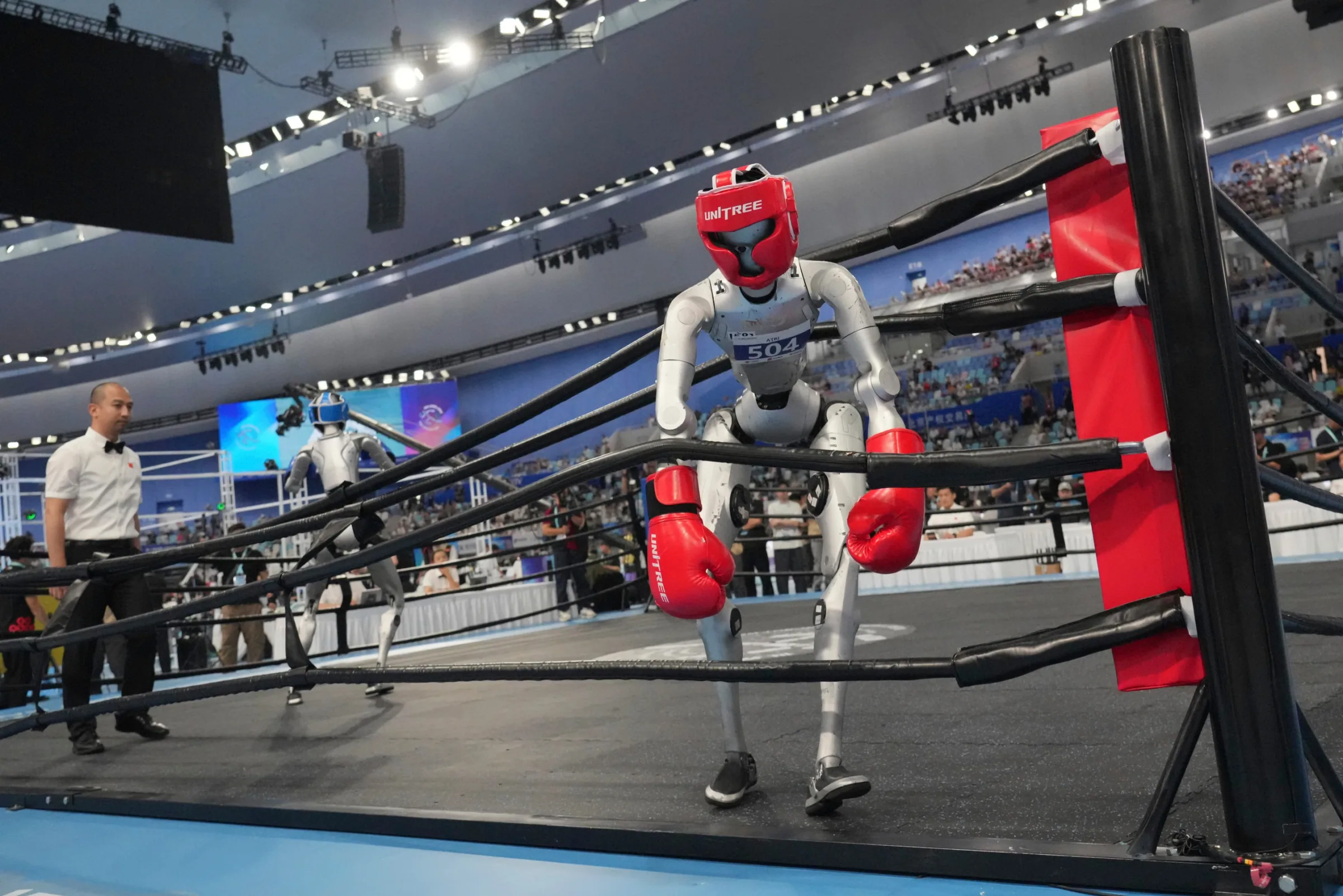
Track and jumping events make for clean headlines: one number, one comparison, one clip that travels. The rest of the program was messier and, honestly, more revealing, because it was less about beating humans and more about whether robots could do ordinary things at all. There was soccer, which one Games report fairly described as slow and collision-prone. There was tug-of-war, a genuinely hard problem in disguise, since it requires coordinating grip strength, rope angle, and balance across a robot's actuators in real time rather than just moving fast in a straight line. There was a full kung-fu routine and a breakdancing set complete with handstands and spins, which is either the most fun or the most unsettling thing at a robotics event depending on your disposition.
The company that actually dominated the week wasn't the one with the viral sprint. It was AGIBOT, the Shanghai humanoid outfit founded by engineer Peng Zhihui, known in China as Zhiyuan Robotics and formally AGIBOT Innovation Technology. On its Games debut, per PR Newswire, AGIBOT walked away with 46 total medals, 18 of them gold, topping both the gold and overall medal tables. It won those medals in the unglamorous events: block-building, powder-weighing, picking beans up with tweezers, hotel-service and emergency-response scenario tasks, plus a 100m obstacle race gold for its X2 platform. None of that trends the way a sub-9-second sprint does, but stacking dexterity and decision-making wins across that many different tasks is arguably the harder engineering feat, and the one closer to what anyone actually wants a humanoid robot to do someday.
One claim about the week needs a straightforward correction, because it's been repeated with the wrong result attached. AGIBOT's Expedition A3 unit did play table tennis at the Games, in a showcase match against Olympic champion Ding Ning, using SpikePingpong, described by Global Times as the first motion-control algorithm built specifically for humanoid table tennis. But that match was an exhibition. It wasn't scored, and Global Times's own coverage doesn't report a winner for it, because a showcase rally with an Olympic champion isn't the kind of thing you're supposed to actually win. The real competitive event, a fully autonomous 12-team bracket, was won by a university squad: a joint Peking University and Beijing Academy of Artificial Intelligence team, which beat the University of Hong Kong's "SMASH" team 2-0 in the final, with a Shanghai Jiao Tong and Shanghai Innovation Institute team taking third, according to Global Times's separate coverage of the tournament. AGIBOT's A3 was the star of the photo op. It wasn't the champion of the actual competition, and those are two different sentences worth keeping straight.v
Result | Detail |
|---|---|
Overall medal table | AGIBOT: 46 total medals, 18 gold; topped both the gold and overall medal tables |
Table tennis, autonomous tournament final | Peking University / Beijing Academy of Artificial Intelligence team defeated University of Hong Kong's "SMASH" team, 2-0 |
Table tennis, third place | Shanghai Jiao Tong University / Shanghai Innovation Institute team |
Table tennis, showcase rally (unscored) | AGIBOT's Expedition A3 vs. Olympic champion Ding Ning |
Every fact above checks out against wire and outlet reporting from the week: the 100m and 400m marks are corroborated across CGTN, Al Jazeera, Global Times, and Tech Times; the jump figures come from CGTN and the Beijing municipal government's own release; and the medal counts and event results are AGIBOT's own reported figures via PR Newswire alongside Global Times's independent Games coverage.
What actually stuck with me from this week wasn't a stopwatch number at all. It was something Stanford robotics researcher Karen Liu told Nature, which covered the same Games: "If I ask you which is harder, folding laundry or doing a backflip, most people will say folding laundry is way easier," but for a robot, "doing a task that we do in our daily lives is actually way harder than a backflip." Nature's piece also notes that robots at these same Games struggled to reliably hammer nails into a corkboard, even when teleoperated by a human wearing motion-capture gloves. Sit with that for a second: a machine that can outrun the fastest sprinter alive and out-jump the honest human benchmark by a meter and a half still can't be trusted to drive a nail straight, even with a person's hands effectively inside it. Both facts describe the same field, in the same week, at the same venue. Neither one cancels the other out. But if you're trying to guess when a humanoid robot is actually walking into your kitchen, the nail tells you a lot more than the sprint does, and it isn't close.