

Meta's New Model Is 92% Cheaper if You Let It Train on Your Prompts. Developers Are Taking the Deal.
Muse Spark 1.3 discounts developers who let Meta train on their prompts. The math, and what Wang's 'double-digit' adoption claim actually proves.
Mark Zuckerberg called Muse Spark 1.3 "frontier performance almost too cheap to meter" when Meta shipped it on September 2. He wasn't wrong about the ceiling. Standard API pricing is $1.25 per million input tokens and $4.25 per million output tokens, cheap enough to undercut most of the frontier field on paper. He just left out that there's a second, much lower price, and the only way to get it is to let Meta read and train on everything you send.
That second tier is the actual story here. Meta calls it the contributor tier: $0.10 per million input tokens and $0.20 per million output, roughly 12.5 times cheaper on input and 21 times cheaper on output than the standard rate, in exchange for permission to use your prompts and completions as training data for future Meta models. Alexandr Wang, the former Scale AI chief executive who now runs Meta Superintelligence Labs, has said a "meaningful double-digit" percentage of developers are already choosing it, according to reporting from Tech Times. Worth sitting with that phrase for a second: it is not a number, it is a range wide enough to mean 10 percent or 89 percent, and Meta hasn't published telemetry to narrow it down. Take it as a claim from the guy running the division that benefits from the number sounding big, not as an audited figure.
What actually shipped
Strip out the pricing angle for a moment and Muse Spark 1.3 is a legitimate, if incremental, model. It's a multimodal reasoning system built for agentic and coding workflows: text, image, video, audio, and document input, text output, a 1,048,576-token context window, and two selectable reasoning depths, "xhigh" and "max." Meta's own launch post says it needs roughly 20% fewer tool calls and 25% fewer tokens than Muse Spark 1.2 to finish the same agentic tasks, and on Meta's internal long-context retrieval test (MRCR v2) it holds 98%-plus accuracy even out past 500,000 tokens.
The catch, flagged clearly by VentureBeat, is that the best numbers come from "max" mode, which isn't actually available to developers yet. Meta says it's still finishing safety testing. Only Artificial Analysis got to benchmark it, under a limited partner preview, and no API provider is currently serving it. What you can actually call today is "xhigh," which scores meaningfully lower on Artificial Analysis's Intelligence Index: 61, against 62 for the gated "max" configuration. That's a small gap on its face, but it's the same pattern every lab has learned to lean on: benchmark the version nobody can use yet, market the number, ship the weaker version.
Here's how the two configurations actually stack up against the field, using Artificial Analysis's own comparison set:
Model | Configuration | Intelligence Index |
|---|---|---|
Claude Fable 5.1 | max | 66 |
Claude Fable 5.1 | xhigh | 65 |
Claude Opus 5 | max / xhigh | 63 |
Muse Spark 1.3 | max (gated, not shipping) | 62 |
Muse Spark 1.3 | xhigh (what you can actually call) | 61 |
GPT-5.6 Sol | max | ties Muse Spark 1.3 max |
Meta Muse Spark 1.2 (August 2026) | n/a | 57 |
That last row is useful context: GLM-5.3-Flash, the open-weight model Z.ai released the same week Muse Spark 1.2 was still fresh, scored an identical 57 on the same index, for a fraction of the price and with weights you can actually download. Muse Spark 1.3's real jump from 1.2 to a shipping score of 61 is genuine progress. It's also still behind both Claude models it's most often compared to, not ahead of them, whatever "caught up with Anthropic and OpenAI" headlines suggested at launch.
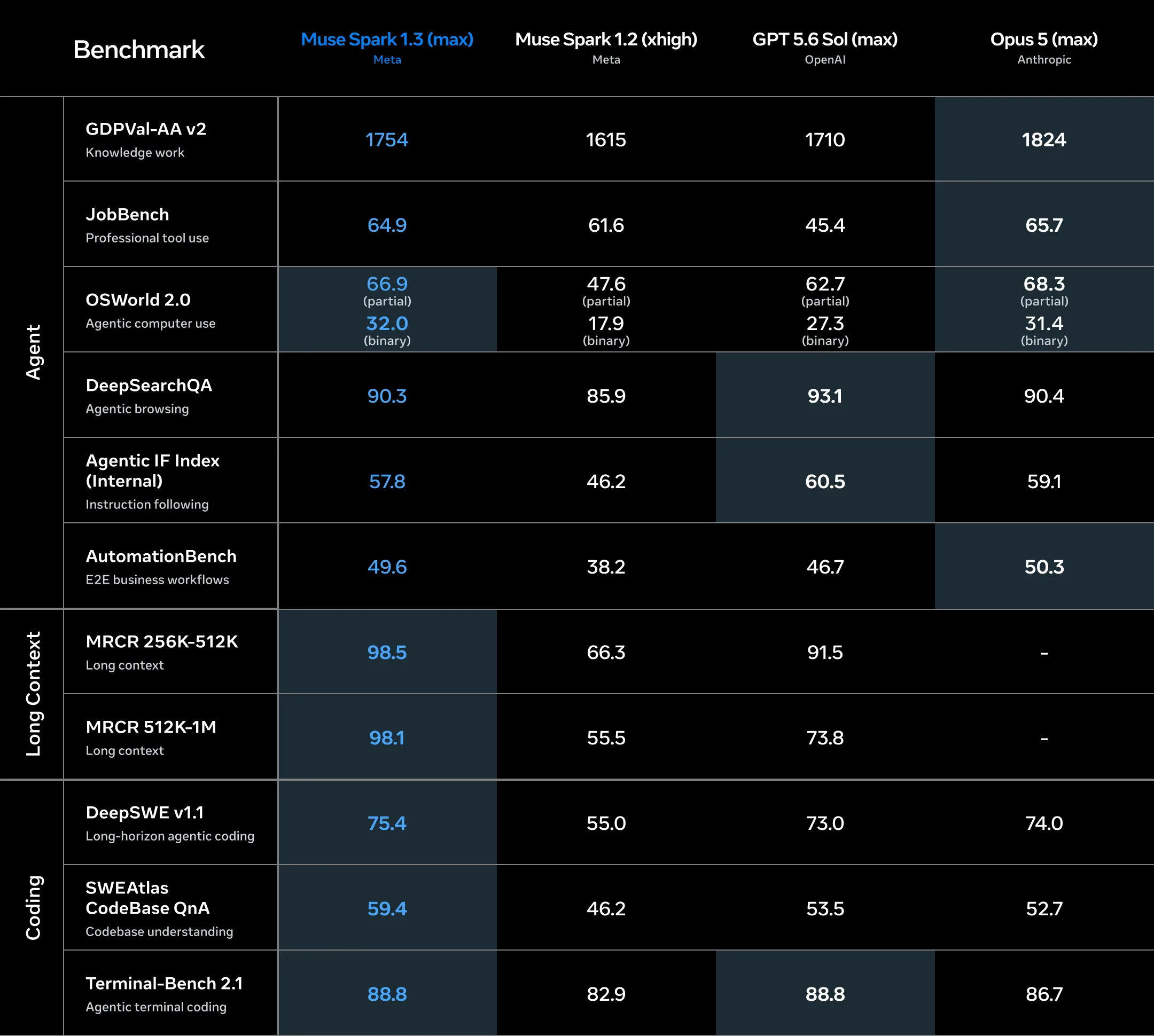
On task-specific benchmarks the shipping version does look strong: 75.4 on DeepSWE v1.1 (against 74.0 for Claude Opus 5 and 72.7 for GPT-5.6 Sol), 89.2% on Terminal-Bench 2.1, and an OSWorld 2.0 score of 57.2 in xhigh mode that jumps to 66.9 once you're allowed to use "max." There's a wrinkle even in the efficiency story Meta is telling, though: despite unchanged per-token pricing, Artificial Analysis found the actual cost to complete a typical task went up generation over generation, because the model reasons longer before answering. Fewer tool calls per task doesn't automatically mean a cheaper bill if each remaining call carries a heavier reasoning tax. Meta's "20% fewer tool calls" framing is true and also not quite the same claim as "cheaper to run," and the two get blurred together in most of the coverage.
Four releases, five months, no open weights yet
Muse Spark isn't a one-off. It's the flagship product of an aggressive release cadence that dates back to April 2026, when Meta first unveiled the model as what TechCrunch called a "ground-up overhaul" of its AI strategy, following Zuckerberg's well-documented frustration with Llama's standing against OpenAI and Anthropic. That overhaul is why Meta paid roughly $14.3 billion for a 49% stake in Scale AI and installed its founder, Wang, as chief AI officer running the newly formed Meta Superintelligence Labs. Muse Spark 1.1 followed in July, 1.2 in early August, and now 1.3 in September: four releases in five months, a pace that reads less like a research lab shipping when ready and more like a division under real pressure to keep a headline in rotation.
That cadence has a cost, and it shows up in the promises that keep sliding. Zuckerberg said Muse Spark 1.2 would get an open-weight release "in coming weeks" back in August. It's now September, 1.3 has shipped, and the weights for either version still aren't out; Meta's roadmap language has quietly shifted from a commitment to something closer to a hope. The one genuinely open thing to come out of Meta Superintelligence Labs recently is Muse Glimmer, a separate 30-billion-parameter model released under Apache 2.0 in mid-August that's small enough to run offline on a single 24GB consumer GPU. It's a real, useful release, and it's also clearly not the same product line: it's the compact sibling Meta can afford to give away while the flagship stays closed and monetized.
The tier that wants your prompts
Back to the discount. Here's the full pricing picture, standard against contributor:
Standard | Contributor | |
|---|---|---|
Input | $1.25 / million tokens | $0.10 / million tokens |
Output | $4.25 / million tokens | $0.20 / million tokens |
Cached input | $0.15 / million tokens | $0.002 / million tokens |
Rate limit | 3,000 requests/minute | 100 requests/minute |
Data use | Not retained for training | Used to train future Meta models |
That rate-limit line rarely makes it into the coverage of this launch, and it matters: the contributor tier isn't just "the same model, cheaper." At 100 requests per minute it's throttled to roughly 3% of standard throughput, which rules it out for most production traffic regardless of what a team is willing to share. What it's actually built for is exactly what it sounds like: side projects, prototyping, and lower-stakes workloads where a team is fine trading data access for a much smaller invoice.
The bigger issue, laid out well by Tech Times, is how thin the consent mechanism is. Switching from standard to contributor pricing is a one-word change in an API call, the model ID string itself (muse-spark-1.3 versus muse-spark-1.3-contributor), not a separate contract, procurement step, or security review. An individual engineer can flip a company's data-sharing posture by editing a config file, and most enterprise security tooling has no way to flag that as a data-classification event because structurally it isn't one, it's just an endpoint name. Meta's documentation, per that same reporting, doesn't specify retention periods, whether humans review submitted prompts, whether data can be deleted after the fact, or whether file attachments and tool-call arguments count as trainable material alongside the prompt text itself.
None of that means Meta is doing anything illegal, and it's worth being precise about what this is and isn't: it's an opt-in product tier for API customers, not covert surveillance. But it's also not the first time this specific company has run into trouble with vague boundaries around what counts as trainable data. In June, Meta paused an internal program called the Model Capability Initiative after a security failure exposed employee keystrokes and private conversations that the program had been quietly logging to train models. That was an employee monitoring tool, a different system entirely from the contributor API tier, and conflating the two would be unfair. But it's a recent, well-documented example of the same underlying instinct: collect broadly first, define the guardrails later. A developer deciding whether to flip that model ID string is entitled to notice the pattern.
Landing in a three-day pileup
Timing is its own part of the story. Claude Fable 5.1 shipped September 1, Muse Spark 1.3 landed September 2, and OpenAI's GPT-6 Astra rolled out September 3. Three frontier-lab releases inside 72 hours isn't coincidence so much as a reasonably predictable outcome of three companies all racing toward the same fall product cycle, but it does put Meta's pricing move in useful context. Muse Spark 1.3 isn't clearly the smartest model that week, Claude Fable 5.1 outscores it on the same Intelligence Index by a solid margin. It's making its case on cost and speed to iterate instead, undercutting the field on standard pricing and undercutting itself even further for anyone willing to hand over training rights.
That's a coherent competitive strategy, arguably a smarter one than trying to out-benchmark Anthropic outright this cycle. It's also worth naming plainly: the "almost too cheap to meter" framing was true of the sticker price and silent about the trade a meaningful share of Meta's own developers are apparently making to get there. Judge Muse Spark 1.3 as a capable, genuinely improved, still second-tier-on-raw-intelligence agentic model with an aggressive price. Judge the contributor tier as what it is: a real discount, attached to a data deal Meta hasn't finished explaining, that a double-digit and entirely self-reported share of developers have decided is worth taking anyway.