
Z.ai Didn't Retrain GLM-5.3. It Just Trained It Meaner.
GLM-5.3 ties a rival four times its size through harder RL, not a new pretrain, and its license quietly excludes the hyperscalers big enough to undercut Z.ai.
Z.ai didn't build a new model to make GLM-5.3 the best open-weight system you can currently get your hands on. It reused the same pretrained base as its predecessor, GLM-5.2, the same underlying network, and got radically better at a narrow list of things through post-training alone: coding, operating a terminal, and, per the company's own numbers, finding software exploits. That's most of the story, and by independent scoring from Artificial Analysis, it works: GLM-5.3 ties for the top open-weight slot with Kimi K3, a rival model with nearly four times its parameter count. The other story, buried a few paragraphs into the release notes, is a new license that has nothing to do with parameters and everything to do with exactly which companies Z.ai does not want reselling this model.
Same weights, a much meaner training run
Some scene-setting first. This is the full GLM-5.3, not GLM-5.3-Flash, the smaller, vision-capable, far cheaper sibling Z.ai (formerly Zhipu AI) shipped the same week under its own strange, quasi-stealth launch under the "Ox Alpha" name, a whole separate story worth its own read. The full model here is text-only, no images in, no vision. The API went live August 14, 2026; the open weights followed on Hugging Face on August 28, after what Z.ai described as an extended safety review given the model's new capabilities around finding software vulnerabilities.
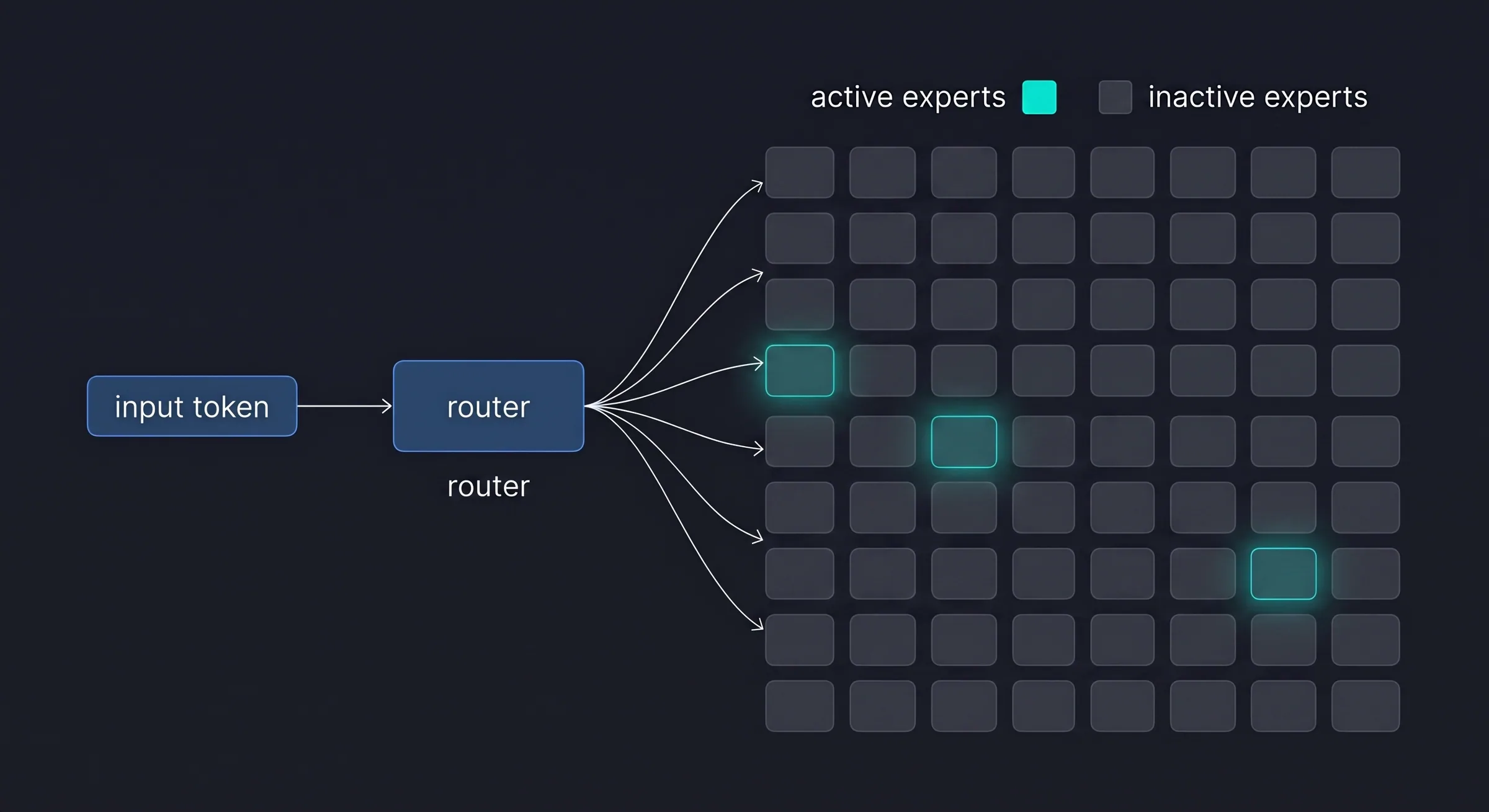
The headline spec is 753 billion total parameters, arranged as a mixture-of-experts (MoE) network: a design where only a small slice of the full model actually fires for any given token, roughly 40 billion active parameters here, rather than running the whole thing on every pass. That's the only reason a 753B model is runnable outside a hyperscaler's data center at all: you're paying compute for 40B active parameters, even though you still have to store and load all 753B of them somewhere. In the fp8 weights Z.ai ships by default, that storage bill runs about 756GB; the full-precision bf16 version roughly doubles it.
Here's the part actually worth sitting with. Per Z.ai's own writeup and independent reporting from MarkTechPost, GLM-5.3 is not a new pretrain. It's GLM-5.2's base model, with every benchmark gain coming from reinforcement learning (RL, a post-training technique that rewards a model for good outputs rather than just having it predict text) scaled harder against a short, deliberate list of tasks. The gains are not subtle. Z.ai's own numbers show ExploitBench, a benchmark for finding and exploiting software vulnerabilities, jumping from 24.4% to 54.4%. Terminal-Bench 3.0, which tests an agent's ability to actually operate a command line, goes from 4.6 to 28.3. Those are the kind of jumps you'd expect from a full retrain, not a second lap of fine-tuning on weights that never changed.
The four-times-the-size problem
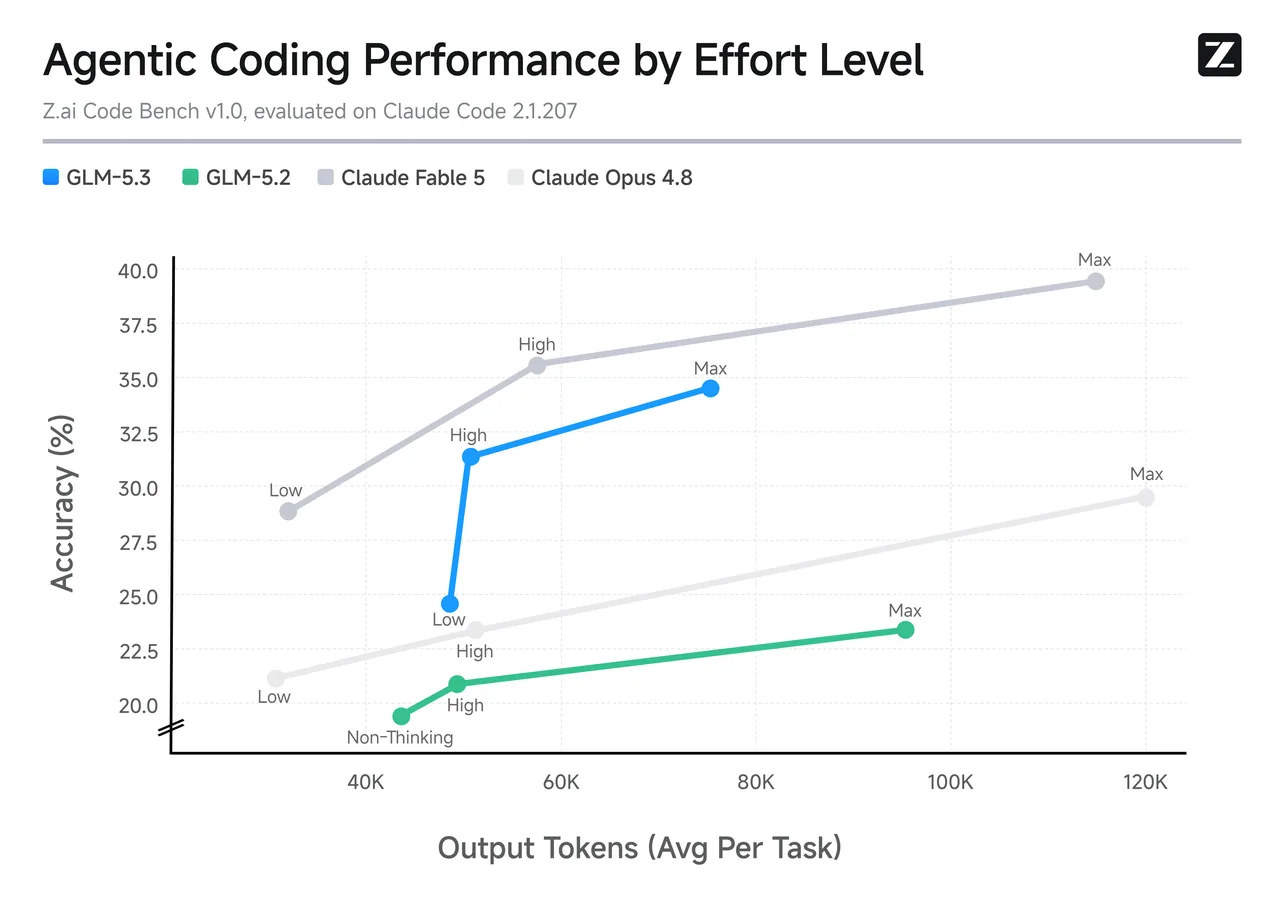
Z.ai's own Code Bench numbers make the efficiency case even more directly. At "High" reasoning effort, GLM-5.3 scores 31.4% using roughly 50,000 output tokens per task. Claude Opus 4.8 needs about 120,000 tokens, more than double, to land at 29.5%, a slightly worse score for more than twice the compute. GLM-5.3 isn't winning everywhere: Claude Fable 5 still leads the hardest coding evaluations at 39.5%, and GPT-5.6 Sol edges it out specifically on cybersecurity exploitation benchmarks. But "competitive almost everywhere while burning a fraction of the tokens" is a real result, not a marketing gloss.
Model | Z.ai Code Bench score | Output tokens per task |
|---|---|---|
GLM-5.3 (High effort) | 31.4% | ~50,000 |
Claude Opus 4.8 (Max effort) | 29.5% | ~120,000 |
Claude Fable 5 (Max effort) | 39.5% | not disclosed |
Z.ai's own internal benchmark; independent, third-party verification of Code Bench specifically is still pending, per MarkTechPost's reporting.
The comparison that actually matters is Kimi K3, the open-weight model GLM-5.3 gets measured against constantly. Kimi K3 runs 2.8 trillion total parameters with 104 billion active, nearly four times GLM-5.3's total parameter count. On Artificial Analysis's Intelligence Index, a composite score built from a broad set of independent benchmarks, they land in exactly the same place: 60 points apiece, tied for the top open-weight spot. GLM-5.3 gets there for roughly a third of Kimi K3's API price, $0.90 versus $2.31 per million tokens, and at nearly double the throughput, 70 tokens per second against 38.
GLM-5.3 | Kimi K3 | |
|---|---|---|
Total / active parameters | 753B / ~40B | 2.8T / 104B |
Artificial Analysis Intelligence Index | 60 | 60 |
API price (per 1M tokens) | $0.90 | $2.31 |
Output speed | 70 tok/s | 38 tok/s |
Source: Artificial Analysis's GLM-5.3 vs Kimi K3 comparison.
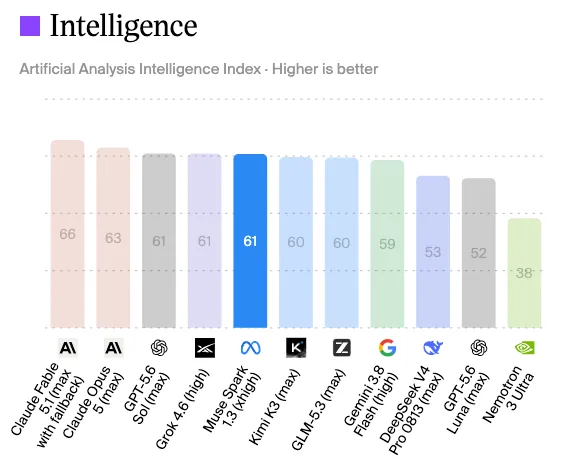
Nathan Lambert's read on this at Interconnects is the right one, and it's not an architecture story. Z.ai is winning on execution: faster release cycles than most Western labs, RL scaled aggressively against a narrow slate of high-value tasks, and, per his analysis, access to a fast-growing Chinese RL-data-labeling industry that makes that kind of scaling cheaper to run. If he's right, the interesting competitive axis in open-weight models right now isn't raw parameter count, it's who can run more RL loops on better-labeled data, faster. That's a different race than the one the parameter-count leaderboards make it look like everyone's running. Independently, the near-parity-with-closed-models framing mostly checks out too, if you're precise about it: Claude Opus 5 sat at 63 on the same index when GLM-5.3 landed at 60, a real but narrow three-point gap, and by the following month Claude Fable 5.1 had pushed the proprietary lead back out to 66. Open models keep closing distance on a target that keeps moving.
Why the license reads the way it does
None of this happens in a vacuum. Z.ai, formerly Zhipu AI, has been building the GLM line since 2019, longer than most of the labs it now gets compared against have even existed, and it just posted a reported $112 billion private valuation as of May 2026, on top of roughly $1 billion in annualized revenue built substantially on on-premises enterprise deployments. That detail matters more than it looks: Z.ai's actual paying customers are largely enterprises running its models on infrastructure they control, not renting inference by the token from a hosted API. A 753-billion-parameter model you can genuinely self-host, if you're willing to pay for the hardware, is a direct product of that business, not a side project.
It also explains something the release notes buried a few paragraphs down: GLM-5.3 did not ship under MIT. Every GLM release since the ChatGLM3 era, GLM-5.2 included, moved toward a fully permissive MIT license. GLM-5.3's license is different: nearly MIT-identical, with one carve-out. Any Model-as-a-Service operator whose aggregate revenue, counting affiliates, exceeds $10 billion over any rolling 12 months has to pass an undefined "Z.AI security review" before commercial use. For nearly every reader of this piece, that clause is invisible; you're not clearing $10 billion in MaaS revenue. But read plainly, it draws a line around exactly one category of company: the hyperscalers, the AWS/Azure/Google Cloud tier, who could otherwise take an open-weight model this capable and resell inference on it at a scale that competes directly with the on-prem enterprise business actually paying Z.ai's bills. No published review criteria, no stated timeline, no appeal process. It's not a landmine for you or me. It's a fence, built by a company with hyperscaler-scale ambitions of its own, around the one customer segment large enough to threaten it. Worth watching whether that $10 billion floor creeps lower by GLM-5.4.
What "run it yourself" actually costs
Set the license aside. For the overwhelming majority of people reading this, the real gate on "you can run the best open model yourself" isn't legal, it's financial. The community moved fast: Unsloth shipped Dynamic GGUF quantizations (quantization compresses a model's weights to a lower precision, trading some accuracy for a much smaller footprint) within days of the weights landing, with combined RAM-plus-VRAM requirements running from about 223GB at the most aggressive 1-bit compression up to 810GB at 8-bit. Unsloth's own recommended middle ground, a 2-bit UD-IQ2_M quant at roughly 239GB, is pitched as workable on "256GB RAM devices like 2x NVIDIA DGX Sparks or a Mac Studio."
Quant | File size | RAM + VRAM needed | Top-1 accuracy |
|---|---|---|---|
UD-IQ1_S (most aggressive) | 217GB | 223GB | 72.6% |
UD-IQ2_M (Unsloth's recommended floor) | 239GB | 245GB | 78.5% |
UD-Q4_K_XL (mid-range) | 467GB | 475GB | 94.3% |
UD-Q8_K_XL (least lossy) | n/a | 810GB | n/a |
Source: Unsloth's GLM-5.3 documentation.
Pricing that out: two NVIDIA DGX Sparks, 128GB of unified memory each, at roughly $4,699 apiece at current retail, get you to that 256GB threshold for about $9,400. That's the realistic floor, genuinely closer to "buy two mini PCs" than "build a server room," and it's the path Unsloth's own guidance actually points toward. It's also unified memory, not discrete GPU VRAM, so expect noticeably slower generation than whatever numbers Z.ai quotes off its own API.
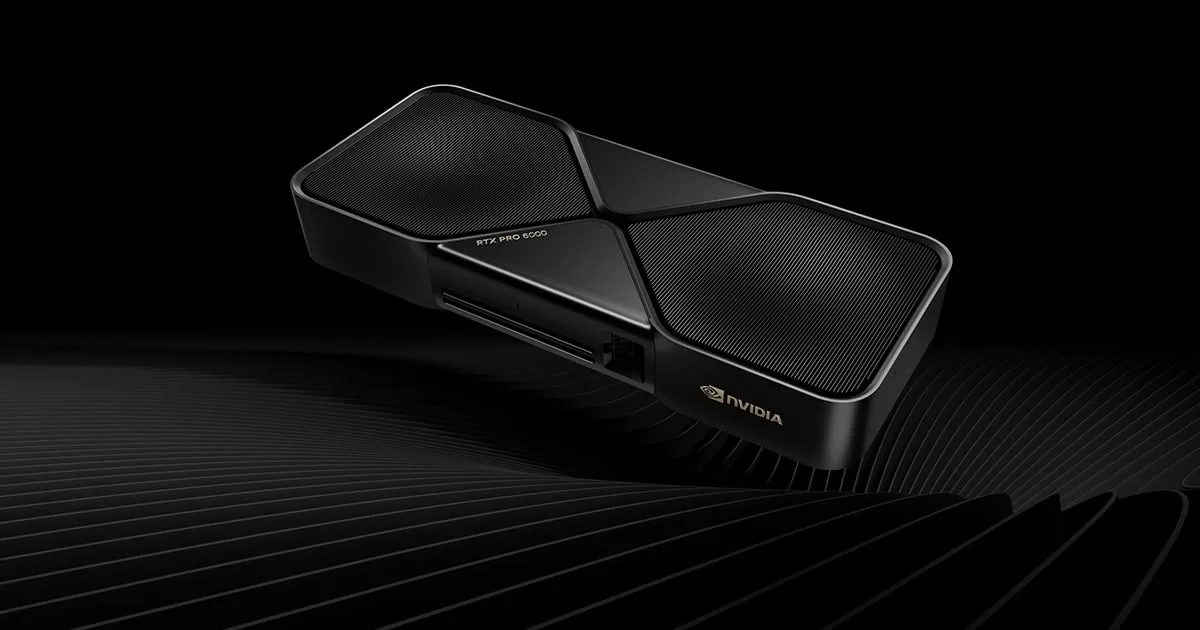
If you want real GPU throughput instead, the setup people actually picture when they say "run it locally," you're pricing Nvidia's RTX PRO 6000 Blackwell, 96GB per card, whose MSRP Nvidia itself raised to $13,250 this year, with street prices running as high as $16,000. Three cards, enough headroom to comfortably run a 2-bit-or-better quant at real GPU speed, runs $40,000 to $48,000. Two cards gets you 192GB for roughly $27,000 to $32,000, tight but workable at the smallest quant sizes. "The best open model you can run locally" is a true sentence. "Locally" is doing a lot of work in it, and for most people who read this far, it means the DGX Spark math, not the GPU rack, if it means anything at all.
Setup | Capacity | Approx. cost | Fits |
|---|---|---|---|
2x NVIDIA DGX Spark | 256GB unified memory | ~$9,400 | UD-IQ2_M and smaller, at unified-memory speed |
2x RTX PRO 6000 Blackwell | 192GB VRAM | ~$27,000 to $32,000 | Smallest quants, at real GPU speed |
3x RTX PRO 6000 Blackwell | 288GB VRAM | ~$40,000 to $48,000 | 2-bit-or-better quants with comfortable headroom |
Sources: IntuitionLabs' DGX Spark review, MLQ News on RTX PRO 6000 MSRP, TechPowerUp on street pricing.
Put the two threads together and the real story here isn't "open model matches closed frontier." It's a company that figured out how to buy frontier-adjacent performance with RL instead of a bigger pretrain, is charging a fraction of what that performance should cost on paper, and is now quietly fencing off the one class of customer big enough to turn that generosity against its own business model. GLM-5.3 earns "best open-weight model available" on the numbers. Whether it's a model you can actually own depends less on how good it is, it clearly is, and more on whether you're the kind of reader with $9,400 for two DGX Sparks sitting around, or the kind watching Kimi K3 and GLM-5.3 share a leaderboard slot from the sidelines.