
Qwen3.8-Max-0902 Beat Claude Opus 5 on Code. Its Open Weights Didn't.
Qwen3.8-Max-0902 tops Arena's coding leaderboard at a fraction of Claude Opus 5's price. The open weights Alibaba promised turned out to be a different, stripped-down model.
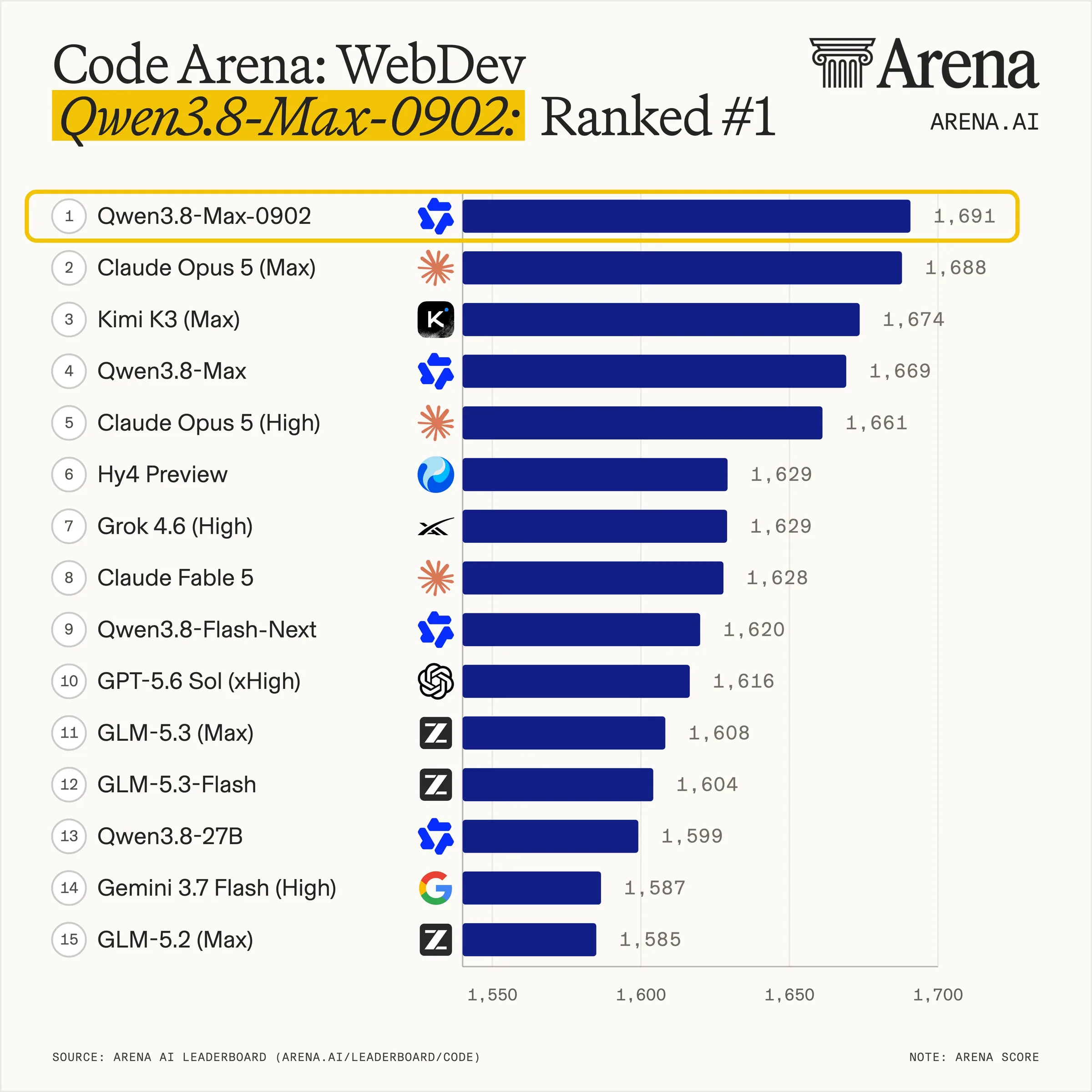
Arena.ai's own account put it plainly the moment the number posted: Qwen3.8-Max-0902 had just debuted at #1 overall on Code Arena's WebDev leaderboard, three points above Claude Opus 5, seventeen ahead of Kimi K3, at a blended price of roughly $5 per million tokens against Opus 5's $15 blended. Alibaba didn't call it Qwen3.9. It didn't call it a new architecture, a new training run, or even a particularly big deal. It's a dated snapshot, a targeted post-training pass bolted onto a model that had already been out for a few weeks, and it walked straight to the top of a leaderboard that Anthropic's flagship was sitting on that same morning.
If that Qwen naming convention looks familiar, it should. A week earlier, Alibaba shipped Qwen3.8-Flash-Next [check_internal_link], a genuinely open-weight 125-billion-parameter model that Alibaba itself described as a rough preview of the Qwen4 architecture. That release earned its "open" framing: real downloadable weights, a real (if newly restrictive) license, and an explicit "this is unfinished, poke at it" pitch. Qwen3.8-Max-0902 is not that model, not the same tier, and not making the same promise, and mixing the two up is an easy mistake to make given Alibaba ships new Qwen SKUs roughly weekly. Max-0902 is the actual flagship: a 2.4-trillion-parameter mixture-of-experts model with about 95 billion active parameters per token, a 1-million-token context window, text, image, and video input, and a pitch aimed squarely at what Alibaba calls "harder engineering projects, autonomous development, and collaborative tool use." It runs exclusively through QwenCloud's API, at $2 per million input tokens and $6 per million output. There is no download link for it, and that turns out to be the actual story.
What "Max" means here, and what changed on September 2
Qwen3.8-Max isn't new. Alibaba previewed it at Shanghai's World AI Conference on July 19, two days after Moonshot AI shipped the 2.8-trillion-parameter Kimi K3 as open weights, a timing nobody in the coverage bothered pretending was coincidental. The full model launched in August under the tagline "a new bar for coding and cowork," with a benchmark table Alibaba described as putting it "second only to Fable 5" and an Artificial Analysis Intelligence Index score of 56, the highest of any non-American lab at the time and, worth flagging, identical to what the much smaller Flash-Next later posted on the same index a few weeks after.
The 0902 snapshot released September 2 doesn't touch that underlying architecture. It's a further round of post-training, specifically targeted at coding and what Alibaba calls "Cowork" tasks, and the self-reported deltas are large: TerminalBench 3.0 climbs from 11.3 to 29.0, ProgramBench from 10.5 to 28.0, JobBench (Alibaba's internal professional-tasks eval) from 53.4 to 64.0, and its WorkArena Elo from 1,348 to 1,468. The one number here with real outside confirmation is that Code Arena WebDev result: Arena.ai runs that leaderboard independently and has no reason to flatter Alibaba, and its own account put the final tally at 1,691 for Qwen3.8-Max-0902 against 1,688 for Claude Opus 5 (Max), 1,674 for Kimi K3, and 1,669 for the prior Qwen3.8-Max. That's real, it's close, and it's specifically a front-end web development leaderboard, not a claim that this model is broadly smarter than Opus 5.
Everywhere else, the picture is more of a trade than a sweep. CellCog's breakdown and an independent teardown from AI Success Lab both land on the same read: Opus 5 still leads on its own TerminalBench measurement (42.7 versus Qwen's 29.0), on DeepSWE, and on NL2Repo, and Claude Fable 5 (the model Anthropic's own September 1 launch built on) still posts an SWE-bench Pro score of 80.0 against Qwen3.8-Max's 67.7. Where 0902 actually wins is narrower and specific: repository-level code comprehension, front-end web development, and SaaS-style workflow automation. AI Success Lab's own summary line is worth quoting directly, because it's more honest than most vendor-adjacent coverage bothers to be: "this is not a Claude-killer, it is a gap-closer with a category win in repo comprehension, at a fraction of the price."
Benchmark | Qwen3.8-Max-0902 | Claude Opus 5 | Claude Fable 5 |
|---|---|---|---|
Code Arena: WebDev (Arena.ai, independent) | 1,691 | 1,688 | not ranked in this leaderboard |
TerminalBench 3.0 (self-reported, both models) | 29.0 | 42.7 | n/a |
SWE-bench Pro | 67.7 | n/a | 80.0 |
Artificial Analysis Intelligence Index (base Qwen3.8-Max, pre-0902) | 56 | not published in this piece's sourcing | 66 |
Qwen3.8-Max-0902's post-training pass targeted coding and agent evals specifically; Artificial Analysis has not published a refreshed Intelligence Index figure isolating the 0902 snapshot as of this writing, so the 56 above reflects the underlying August model, not necessarily the coding-tuned update.
The pricing story has the same asterisk that showed up on GLM-5.3-Flash's own launch [check_internal_link] a week earlier and that we flagged on Flash-Next too: a low sticker price only holds if the model doesn't burn tokens to get there. Per OfficeChai's reporting on the base Max model, real agentic runs needed an average of 64 turns to complete a task, up from 14 on the prior Qwen3.7-Max, pushing effective cost per completed task to around $1.14 to $1.19, still cheap next to the field, but a long way from the $2/$6 headline rate doing all the work by itself.
API pricing (per million tokens) | Input | Output |
|---|---|---|
Qwen3.8-Max-0902 | $2.00 | $6.00 |
Claude Opus 5 | $5.00 | $25.00 |
GPT-6 Astra | $10.00 | $50.00 |
Opus 5 and GPT-6 Astra rates per prior reporting; GPT-6 Astra's launch priced identically to what OpenAI billed at release.
What "autonomous development" actually looked like in the demos
Alibaba's own launch material for the base Qwen3.8-Max is where "autonomous development" and "collaborative tool use" stop being marketing nouns and turn into something you can actually evaluate, even secondhand. The most concrete claim: a roughly 16-day unattended run against an open-source project called oh-my-cli, during which the model normalized incoming requirements into issues, claimed them, and iterated through code, tests, previews, and logs on its own, ending with 265 commits, 127 pull requests, and 151 issues closed with no human in the loop steering individual tasks. In a separate 125-hour run, it reproduced a published research paper's method, then ran what Alibaba calls a self-improving research loop, testing 18 of its own improvement ideas across four rounds of GPU training and landing a 2.7-point gain over the paper's original result on AIME24. In a 24-hour public coding competition against 526 human teams, it climbed from 60% to 85.3% accuracy across 45 submissions, finishing ahead of 458 of the 526 teams entered.
"Collaborative tool use" gets its clearest illustration from an ETF-rotation strategy demo, where the model orchestrated roughly 330 sub-agents in parallel to run about 6,000 backtests, and from what Alibaba calls Hybrid Agent capability, pairing code generation with direct GUI operation so the model can write a change and immediately click through the running application to verify it worked, rather than trusting its own test suite alone. None of this is independently reproduced; it's Alibaba grading its own demo, run on tasks Alibaba selected, with no outside lab confirming the commit counts or the backtest tally. Treat it the way you'd treat any vendor case study: plausible, specific enough to be checkable in principle, and unverified in practice.
The open weights that weren't
Here's where this release earns real skepticism, and it's the part most of the coverage buried under the leaderboard numbers. When Alibaba first launched Qwen3.8-Max in August, its own announcement promised open weights for the model "next week," alongside a smaller Qwen3.8-27B. Those weights did ship, as Qwen3.8-2.4T-A95B on Hugging Face. What shipped is not the model this article is about.
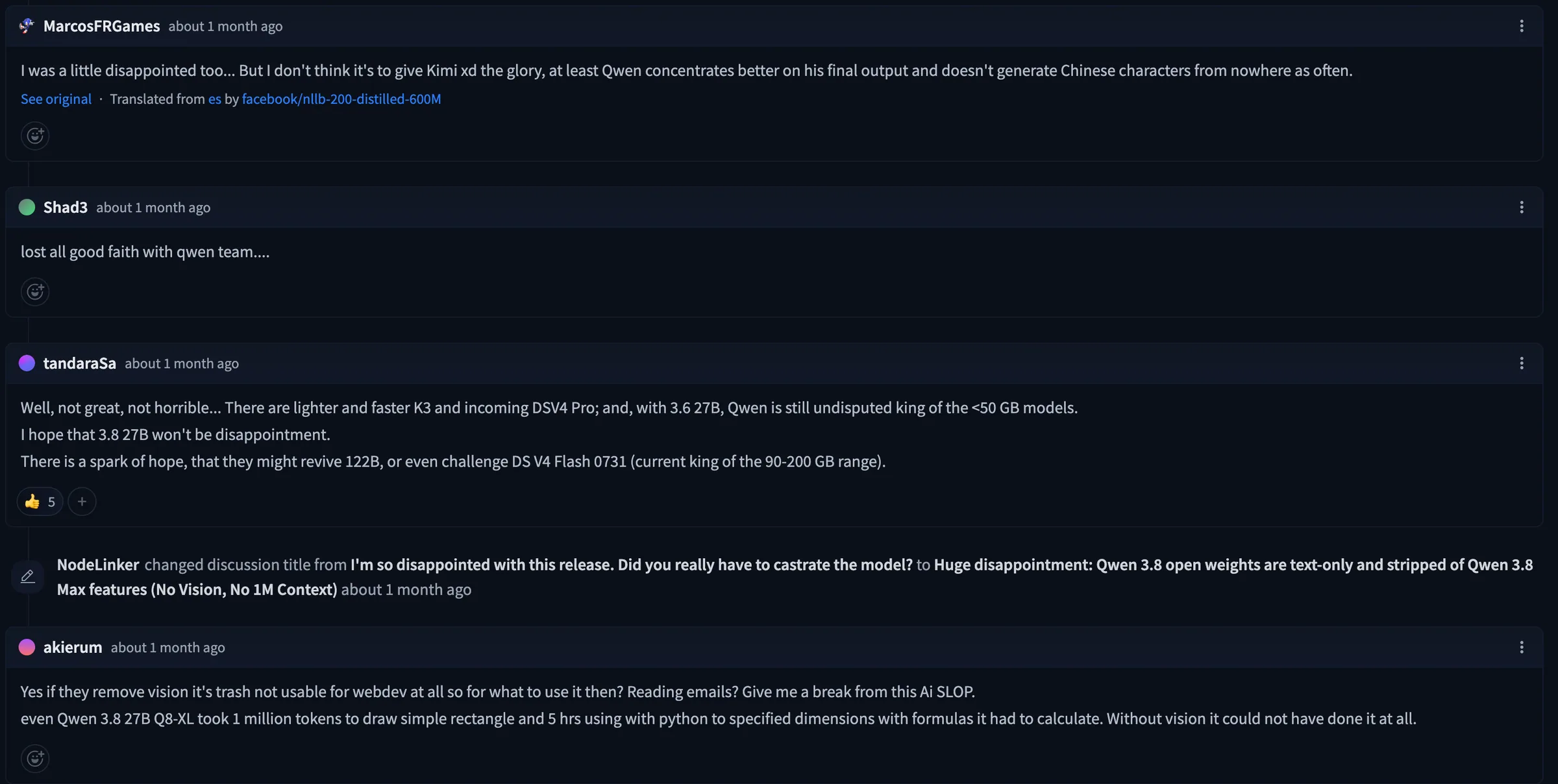
The open checkpoint is text-only, with vision and video support stripped out entirely. Its context window natively tops out at 262,144 tokens, extensible to roughly 1 million with added engineering rather than the 1M default the hosted API ships with. It forces thinking mode on for every single response, with no way to turn it off, unlike the API version where reasoning effort is configurable. And it ships under a new custom "qwen3.8-max" license, not the Apache 2.0 terms most prior Qwen generations used, with revenue-sharing and branding obligations that kick in for products above certain user or revenue thresholds, a pattern LLM Stats' analysis noted mirrors what Moonshot AI has already done with its own flagship releases. A Hugging Face discussion opened within hours of the release, and it did not go well for Alibaba: user NodeLinker wrote that Qwen "made a post on X without giving any hint that the released model weights wouldn't actually be the full Qwen 3.8 Max," and that stripping out vision on a model this strong at vision-language tasks "throw[s] away half its core value." Other commenters reached for a gaming-industry comparison, calling it DLC paywalling dressed up as an open release, and one said flatly that it cost Alibaba "all good faith" built up from prior generations. No Qwen team member had responded in that thread as of this writing.
That distinction is why this piece isn't filed as an open-source story, whatever the family name suggests. Qwen3.8-Max-0902, the specific snapshot topping the coding leaderboard, has no downloadable weights, full stop. It runs on Alibaba's own infrastructure, and, per Tech Times' reporting, on China's National Intelligence Law, Cybersecurity Law, and Data Security Law, all of which apply to whatever code or business data passes through QwenCloud's servers regardless of where the customer sits. China law scholar Jeremy Daum, quoted in that piece, notes the scope of the intelligence-law obligation is legitimately contested, but that every plausible reading of it "involve[s] government access to user data under defined conditions, with no mechanism for companies or their users to opt out." Alibaba itself landed on the Pentagon's Section 1260H list of Chinese military-linked companies in June, barring it from Department of Defense contracts. None of that makes the model less capable at what it's actually good at. It does mean the sales pitch and the actual deployment tradeoff are two different conversations, and a reader deciding whether to route real engineering work through this API should be having the second one, not just reading the leaderboard screenshot.
The gap that's actually closing
UC Berkeley's Ion Stoica, who co-founded the Arena project that just ranked this model, framed the broader trend more usefully than either the leaderboard win or the license complaints: the gap between Chinese open-weight labs and US frontier labs has narrowed to roughly two months, down from six to nine months a year earlier. Qwen3.8-Max-0902 is a data point for that claim, but it's a more complicated one than the headline suggests, because the model doing the gap-closing isn't open at all. Flash-Next, a week earlier, was the genuinely interesting architecture story: real weights, a real preview of where Qwen4 is headed, benchmarked and picked apart by anyone who wanted to download it. Max-0902 is the opposite kind of release: a closed, incrementally tuned flagship that wins one leaderboard cleanly, trades blows on several others, and ships a pricing advantage that's real but smaller once you account for verbosity. Both are true stories about the same lab in the same two weeks. Only one of them is actually about openness.