
GPT Image 2.5's Price Per Token Didn't Change. Nobody Knows the Price Per Image.
GPT Image 2.5 keeps GPT Image 2's rate card, sharper output, layered PSD export, and a sketch-to-image tool. What it costs per finished image is the number OpenAI didn't publish.
OpenAI is framing GPT Image 2.5's launch around a specific line: the quality jump arrives "with no price increase." Check that against the actual rate card and it's true, dollar for dollar, per token. What it skips over is the number that actually decides your bill: how many tokens a sharper, more detailed image now costs to generate compared to before, a figure OpenAI hasn't published. A model can hold its per-token price steady and still cost more per finished image, if it simply needs more tokens to render the extra detail it's being sold on. That gap, between what the rate card says and what a real image actually costs, is the more useful thing to understand about this release than any single benchmark number.
What actually shipped
GPT Image 2.5 isn't one model, it's two. Flare is the default: fast, cheap by the model's own standards, built for high-volume everyday generation. Sunburst trades speed for control, and developer Simon Willison, who tested the API the day it shipped, notes OpenAI's own documentation frames it as the stronger option for production workflows where you're iterating on the same asset repeatedly and need it to hold together. Both replace GPT Image 2 everywhere it currently lives, in ChatGPT (including the free tier), ChatGPT Work, Codex, and the API, and OpenAI says the rollout reached "all ChatGPT, ChatGPT Work, and Codex users across desktop, mobile, and web" starting September 8. Willison also flags a number worth sitting with: OpenAI says its image models, across ChatGPT Images and the API combined, have now generated more than 3 billion images total, which is the kind of scale that makes "did this actually get better" a question that matters to a lot of people at once, not just AI reviewers.
The headline technical changes: up to 50% lower generation latency than GPT Image 2, new quality tiers above the old ceiling (xhigh and max joined low/medium/high), and better handling of transparent backgrounds, to the point that you can now ask it for a layered PSD file with separate transparent elements instead of one flattened PNG. A sketch tool lets you draw a rough shape in ChatGPT and hand it off as a visual reference alongside a text prompt. Axios's Ina Fried, who got early hands-on access, quotes OpenAI's product lead on images, Adele Li, on the thinking behind the sketch tool and templates: "an attempt to make people more engaged," aimed at letting people "express their own individuality" rather than output that reads as obviously AI-made. Fried's review also raises the less comfortable side of that ambition: image models like this one, hers included, are trained on the work of real artists, "usually without consent or compensation," a line worth keeping in view underneath any "look what it can make now" coverage, this piece included.
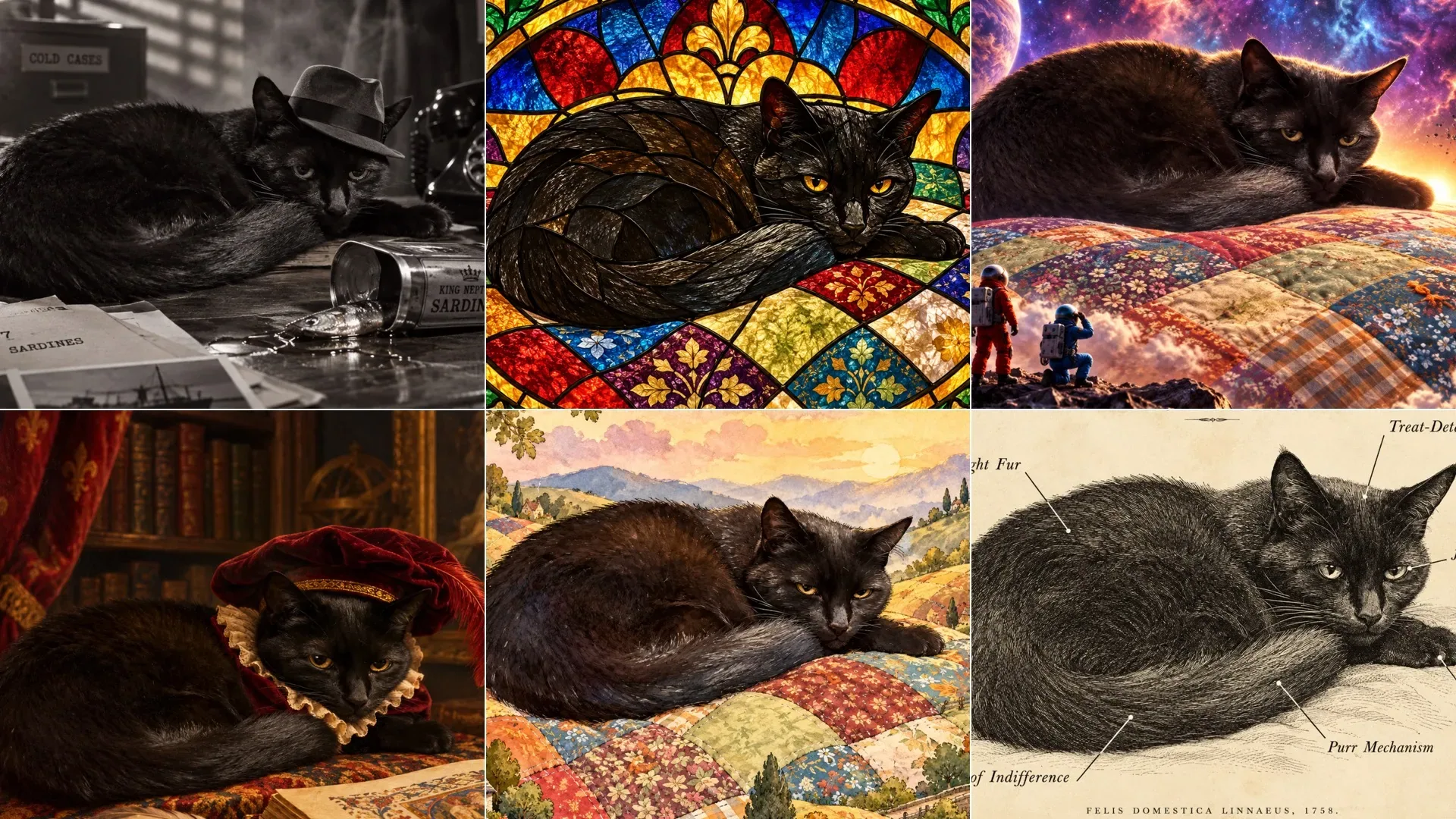
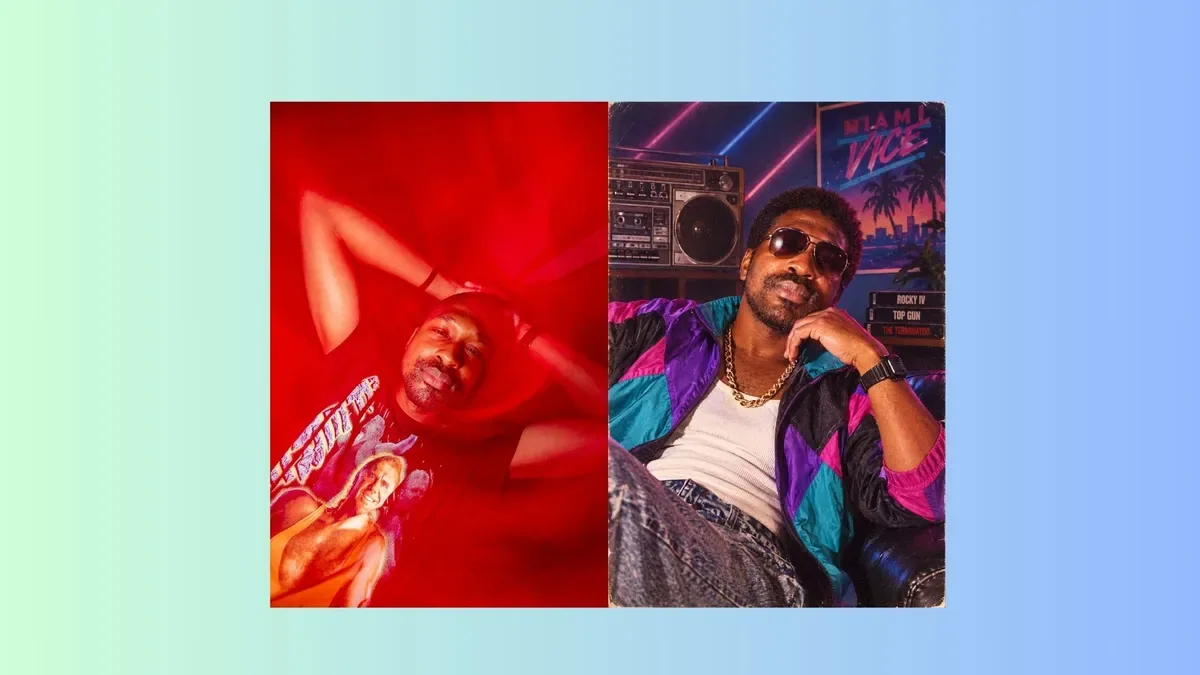
Tom's Guide's Elton Jones ran his own set of prompts the same week, including turning a photo into a stylized '80s-era portrait and generating a full dramatic movie-poster treatment from a single reference shot, and came away "pleased with the finished results" on both. Multi-turn editing (taking one output, editing it, editing that result again, repeatedly) is also holding up noticeably better across a long chain of edits than it used to, which is part of what's behind a wave of people chaining GPT Image 2.5 into crude stop-motion animation, one frame at a time.

The rivalry, right up until this shipped
Nobody had published a credible, independently-run head-to-head of GPT Image 2.5 against Google's Nano Banana 2 specifically as of this writing, which is itself worth noting given how fast this space usually moves. What does exist is a clear picture of how the previous round looked, and it's a useful baseline for what GPT Image 2.5 actually had to improve on. TechRadar's Eric Hal Schwartz ran GPT Image 2 against Nano Banana 2 across lighting, cinematic portrait, product-photography, and seasonal-change prompts, and came away surprised at how consistently GPT's version won on realism: "makes images that feel more real," largely on better light behavior and texture. Daria Cupareanu's independent newsletter ran a separate ten-prompt comparison of the same pairing and reached a similar overall lean toward GPT, especially on character consistency from reference photos and realistic product shots, while crediting Nano Banana 2 with a cleaner, more minimal aesthetic on illustrative work. Neither reviewer called it a rout. Both landed closer to "GPT ahead on realism, Nano Banana competitive on style," which is a meaningfully different story than "best in the world."
If that gap holds into the 2.5 generation, and Arena.ai's early results suggest it might, GPT Image 2.5 arrives already ahead on the thing testers cared about most. But "might" is doing real work in that sentence, and until someone runs the same kind of careful, named, side-by-side test against Nano Banana 2 specifically on GPT Image 2.5, that's a reasonable expectation, not a confirmed result.
The price sticker didn't move. What's inside it might have.
OpenAI's developer community confirms the per-token API rate for both Flare and Sunburst is identical to GPT Image 2's existing rate: $5 per million text input tokens, $8 per million image input tokens, $30 per million image output tokens. OpenAI is framing this as "the quality jump arrives with no price increase," and that's true of the rate card.
What it doesn't tell you is how many tokens GPT Image 2.5 actually burns per image compared to its predecessor, a number OpenAI hasn't published. A model that produces sharper, more detailed output while charging the same rate per token can still cost you more per finished image, if it simply needs more tokens to render that extra detail. Until someone runs a controlled batch and counts, "no price increase" is a claim about the rate card, not about your bill.
Third-party pricing calculators give a sense of what that actually costs once quality and resolution enter the picture. Here's fal.ai's published rate table for GPT-Image-2.5 Sunburst, run by fal.ai, the inference platform actually hosting the model, not a secondhand estimate:
Resolution | Low | Medium | High | XHigh | Max |
|---|---|---|---|---|---|
1024×768 | $0.0040 | $0.0090 | $0.0361 | $0.0642 | $0.1445 |
1024×1024 | $0.0059 | $0.0132 | $0.0527 | $0.0937 | $0.2107 |
1920×1080 | $0.0044 | $0.0103 | $0.0396 | $0.0704 | $0.1584 |
3840×2160 (4K) | $0.0111 | $0.0260 | $0.1001 | $0.1779 | $0.4003 |
A single square image at the lowest quality setting costs about half a cent. Push it to max quality at 4K and you're paying 40 cents for that one image, and longer, more complex prompts push it higher still.
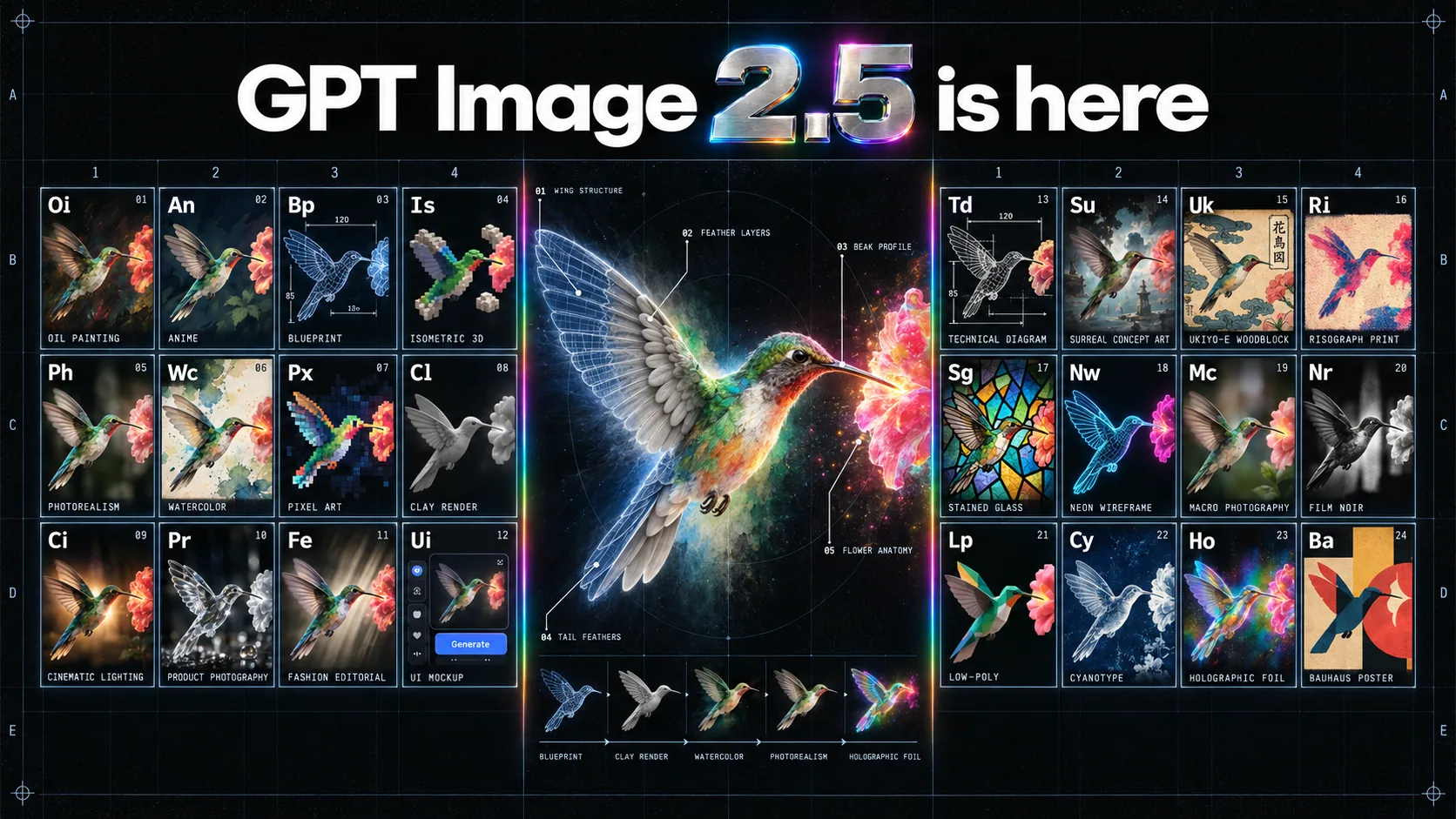
Prompt
Create a high-end hero infographic announcing "GPT Image 2.5 is here."
CONCEPT
A futuristic periodic table of visual styles fused with a museum-grade anatomical specimen plate. The whole poster reads as one precision instrument: engineered, luminous, flawlessly clean. It should feel like a limited-edition print from a Swiss design studio crossed with a launch-keynote hero slide.
FORMAT
Landscape 16:9. Near-black obsidian background with a barely visible graphite grain. A faint hairline construction grid spans the canvas; row and column coordinates (A–F, 1–4) sit in the outer margins like an engineering drawing, with tiny registration marks in the corners.
HEADLINE
"GPT Image 2.5 is here" set large and centered in the top band, in a tight, sharply kerned geometric grotesk. "GPT Image" and "is here" are flat, crisp white type. The "2.5" is a physical object: a single block of machined, brushed titanium with beveled edges, a thin ribbon of spectral light refracting along the bevel and casting a soft cyan-to-magenta glow onto the background. Perfect letterforms, perfect spelling, zero distortion.
THE ONE-SUBJECT RULE
Every panel depicts the exact same subject — a hummingbird frozen in mid-hover, wings blurred, three-quarter view, drinking from a single glowing flower — re-rendered in 24 completely different visual styles. Same pose, same angle, same framing in every tile, so the grid demonstrates identity consistency across styles.
THE GRID (shaped like the periodic table)
Two symmetrical wings of 12 tiles each (3 rows × 4 columns) flank a tall central specimen panel, echoing the two-block silhouette of the periodic table. All 24 tiles are identical in size with mathematically equal gutters, edges locked to the construction grid, nothing cropped, nothing overlapping.
Each tile is styled as an element cell: a two-letter symbol top-left, a small index number top-right, the full style name in tiny monospaced caps along the bottom edge. Borders are 1px cool-grey hairlines with a faint edge-lit glow.
Left wing: Oi Oil Painting · An Anime · Bp Blueprint · Is Isometric 3D · Ph Photorealism · Wc Watercolor · Px Pixel Art · Cl Clay Render · Ci Cinematic Lighting · Pr Product Photography · Fe Fashion Editorial · Ui UI Mockup
Right wing: Td Technical Diagram · Su Surreal Concept Art · Uk Ukiyo-e Woodblock · Ri Risograph Print · Sg Stained Glass · Nw Neon Wireframe · Mc Macro Photography · Nr Film Noir · Lp Low-Poly · Cy Cyanotype · Ho Holographic Foil · Ba Bauhaus Poster
CENTRAL SPECIMEN PANEL
A tall hero panel showing the same hummingbird at large scale in one continuous style sweep: left to right it transitions seamlessly from blueprint linework → clay render → watercolor → photorealism → holographic foil, with no visible seams. Thin anatomical leader lines with numbered callouts extend from the beak, feather groups and wing edge outward toward the matching tiles in the wings, each carrying a tiny monospaced label. A faint diffraction spectrum bleeds along the gutters nearest the panel.
EMBEDDED PROOF-OF-CAPABILITY (subtle)
- All text on every tile is real, legible and correctly spelled, including micro-labels.
- The UI Mockup tile contains a readable miniature interface with actual words and coherent icons.
- The Technical Diagram and Blueprint tiles have accurate dimension lines and readable annotations.
- The Product Photography tile renders the hummingbird as a glass sculpture with physically correct refraction and reflections.
- The Ukiyo-e tile includes a correctly formed vertical Japanese caption block.
- All photographic tiles share one consistent key light from the upper left.
- Feathers, glass, metal and fabric render with no artifacts.
COLOR & FINISH
Restrained spectral palette on obsidian: electric cyan, hot magenta, acid lime and warm amber, used only as edge glows, callout accents and the hero bevel. Thin lines everywhere, generous negative space, strong hierarchy: headline → central specimen → tile grid → micro-labels. Extremely polished, premium, electric.
TYPOGRAPHY
One geometric grotesk for the headline, one monospace for all labels. Sharp, aligned, evenly spaced.
CONSTRAINTS
No date. No tagline. No extra caption. No logos or watermarks. The only text is the headline plus the tile and callout labels.
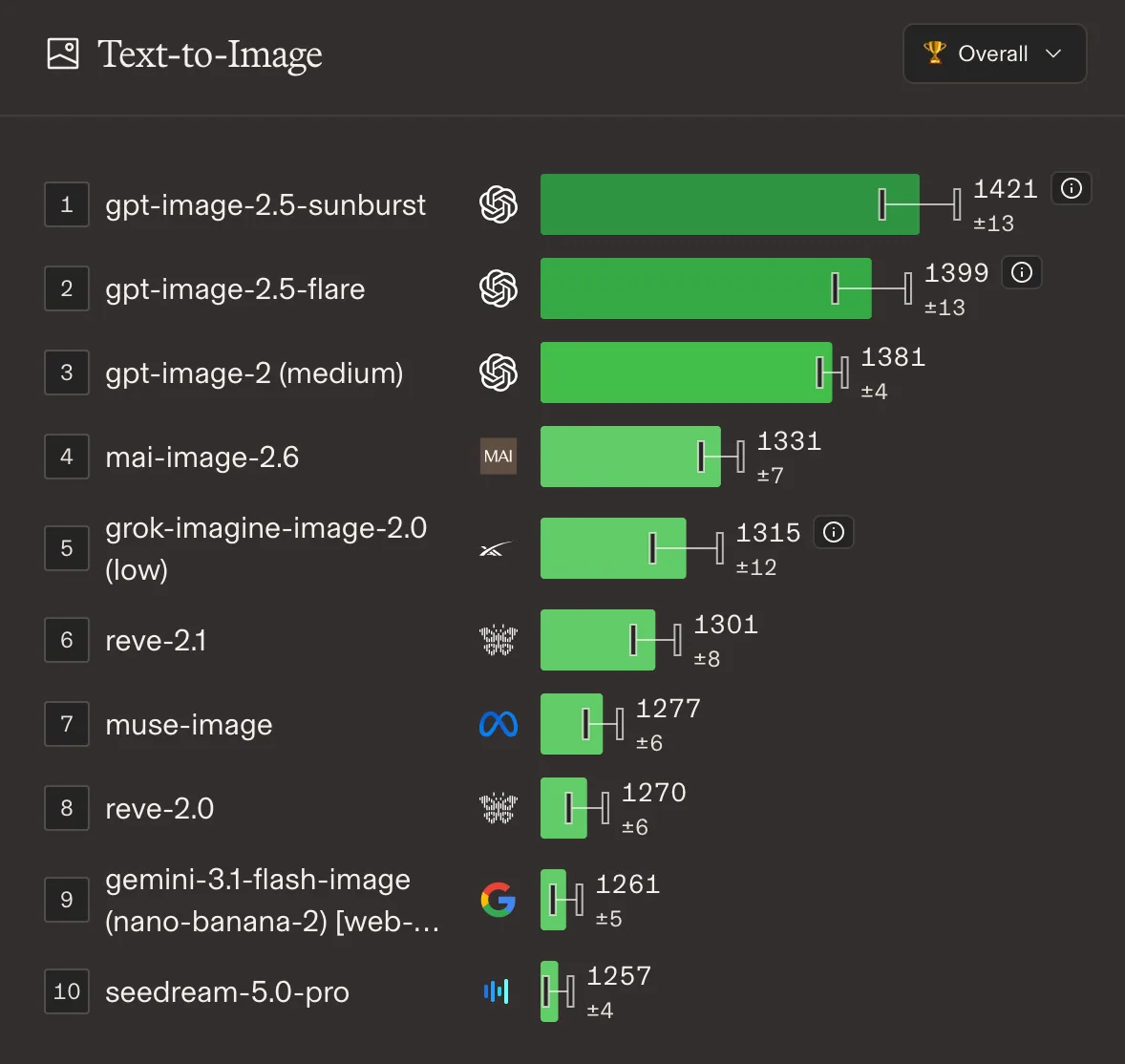
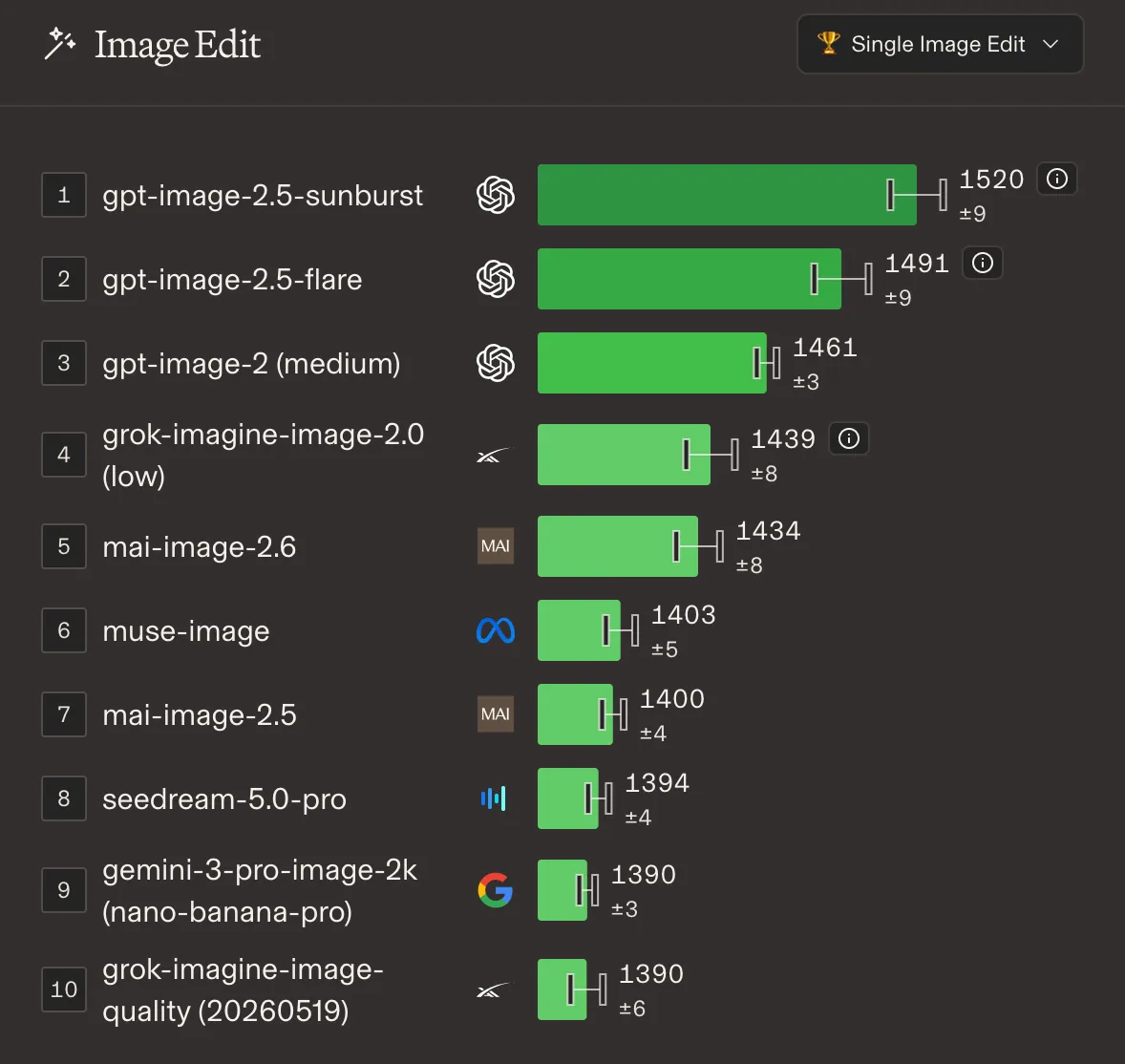
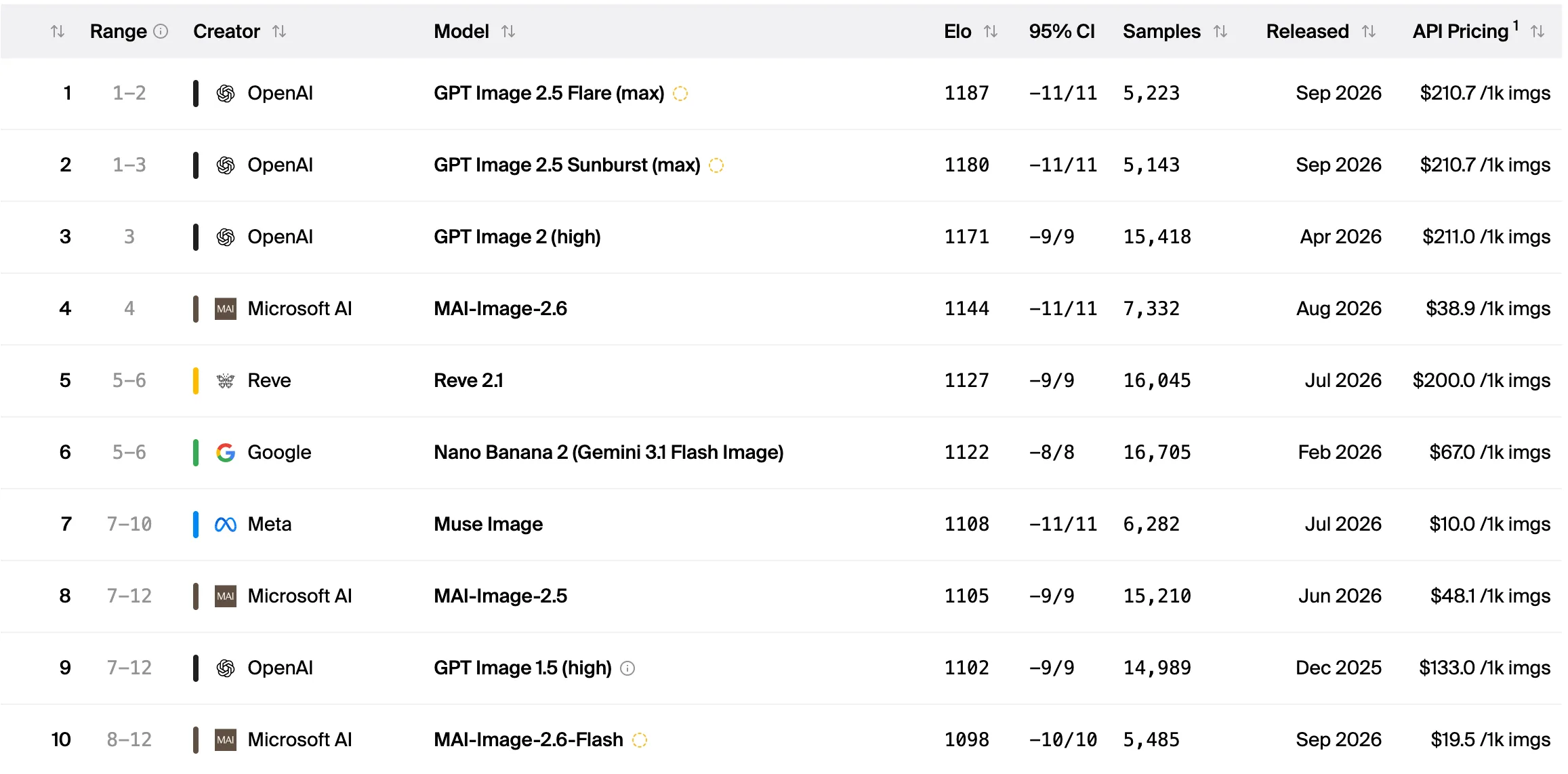
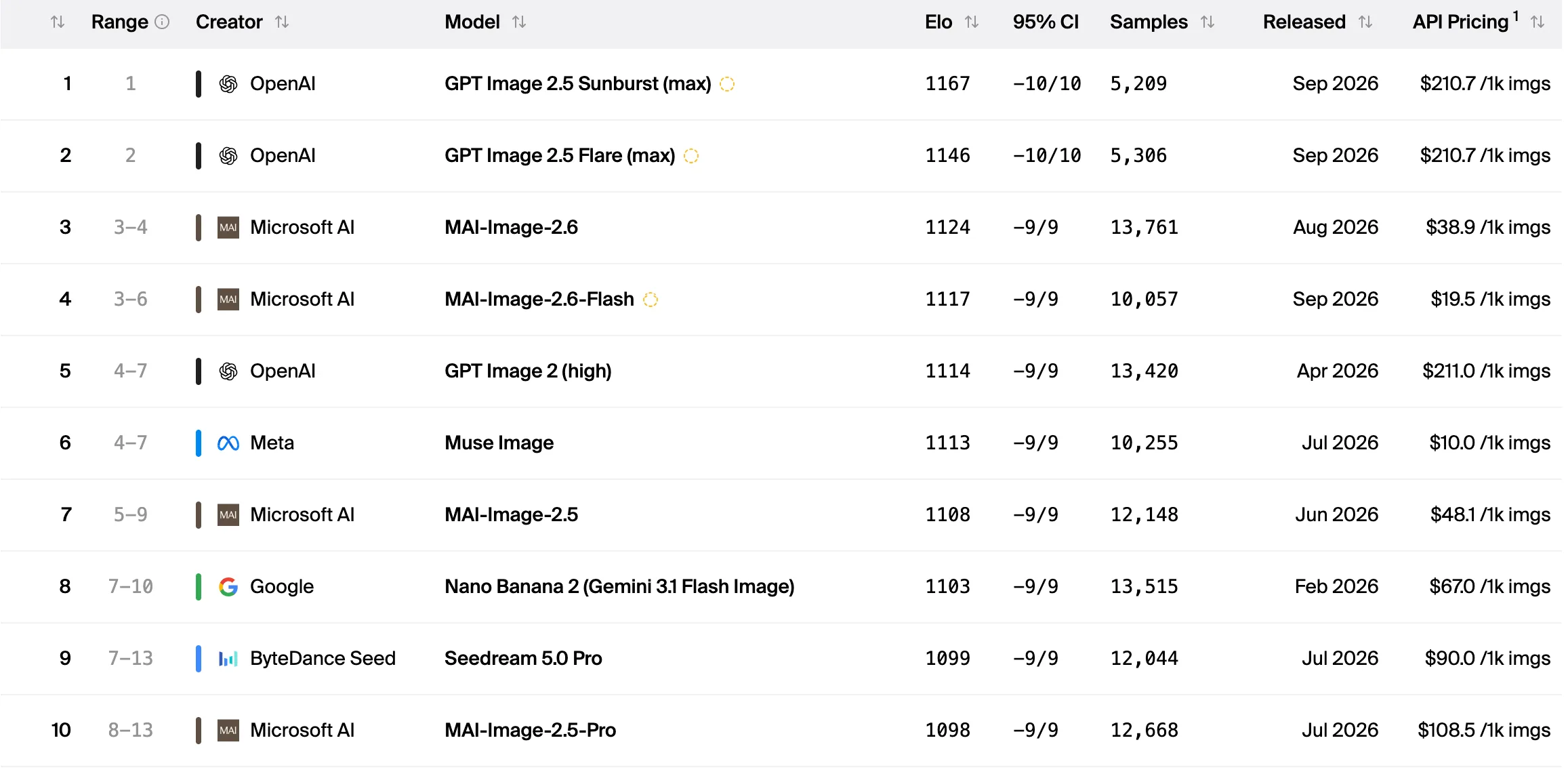
On the blind-vote leaderboards, for what a leaderboard snapshot is worth: Arena.ai's Image Arena has GPT Image 2.5 Sunburst leading both text-to-image and editing, and Artificial Analysis, which took a few days longer to finish running it through their evaluation pipeline, has since landed in the same place: Flare (max) at #1 for text-to-image, Sunburst (max) at #1 for editing. Worth knowing if you like a number to point at, not worth building the whole case for this model on, since a rank on any single leaderboard is a snapshot that moves the moment the next model ships.
None of this means GPT Image 2.5 is bad. Sharper detail, real transparent-layer export, and materially better multi-turn consistency across repeated edits are genuine, useful upgrades over GPT Image 2, and the free-tier rollout means anyone with a ChatGPT account can go check the sketch tool and layered exports themselves today without paying for API access. Independent hands-on reviewers who got early access came away broadly impressed, not skeptical. Worth noting too that Astra, OpenAI's flagship reasoning model launched a few days earlier, still can't generate images natively. Image generation on this scale stays a separate, dedicated model, not a side effect of a bigger brain.
If you're deciding whether to switch, the practical read is this: Flare is the one to reach for by default unless you're specifically iterating on the same asset over many edits, where OpenAI itself positions Sunburst as the better fit. Budget for roughly a cent to a nickel per image at everyday quality settings, and expect that to climb fast if you push resolution and quality to the max simultaneously, and treat "no price increase" as a statement about the rate card, not a promise about your actual bill, until OpenAI publishes the one number that would settle it: tokens per image, before and after.