

MiniMax's H3 Video Model Gets a 14x Speedup, Trained on Footage Nobody Ever Filmed
FastH3 cuts MiniMax H3 from 49 sampling steps to 4 using training data the model generated for itself, no real footage involved. The 14x number is real, on 8 B200s. I checked what a 4090 actually gets you, and what the license quietly locks out.
I've been meaning to write about how slow open video models are to actually iterate on, and then Hao AI Lab, the UC San Diego group behind the FastVideo inference stack, went and made that complaint half-obsolete for one specific model. MiniMax H3, the 33-billion-parameter checkpoint that generates text, image, video, and synced stereo audio without bolting on a separate audio model, has been the open video generator people actually reach for since it dropped in early August. It's also slow: a full 49-step diffusion run is the kind of wait that turns "let me try five prompts" into "let me try one prompt and go make coffee." Hao's answer is FastH3, a distilled version of H3 that claims up to a 14x speedup. That number is the headline everyone's repeating. The thing that actually made me stop and reread the release notes is smaller and weirder: FastH3 was trained without a single frame of video anyone ever pointed a camera at.
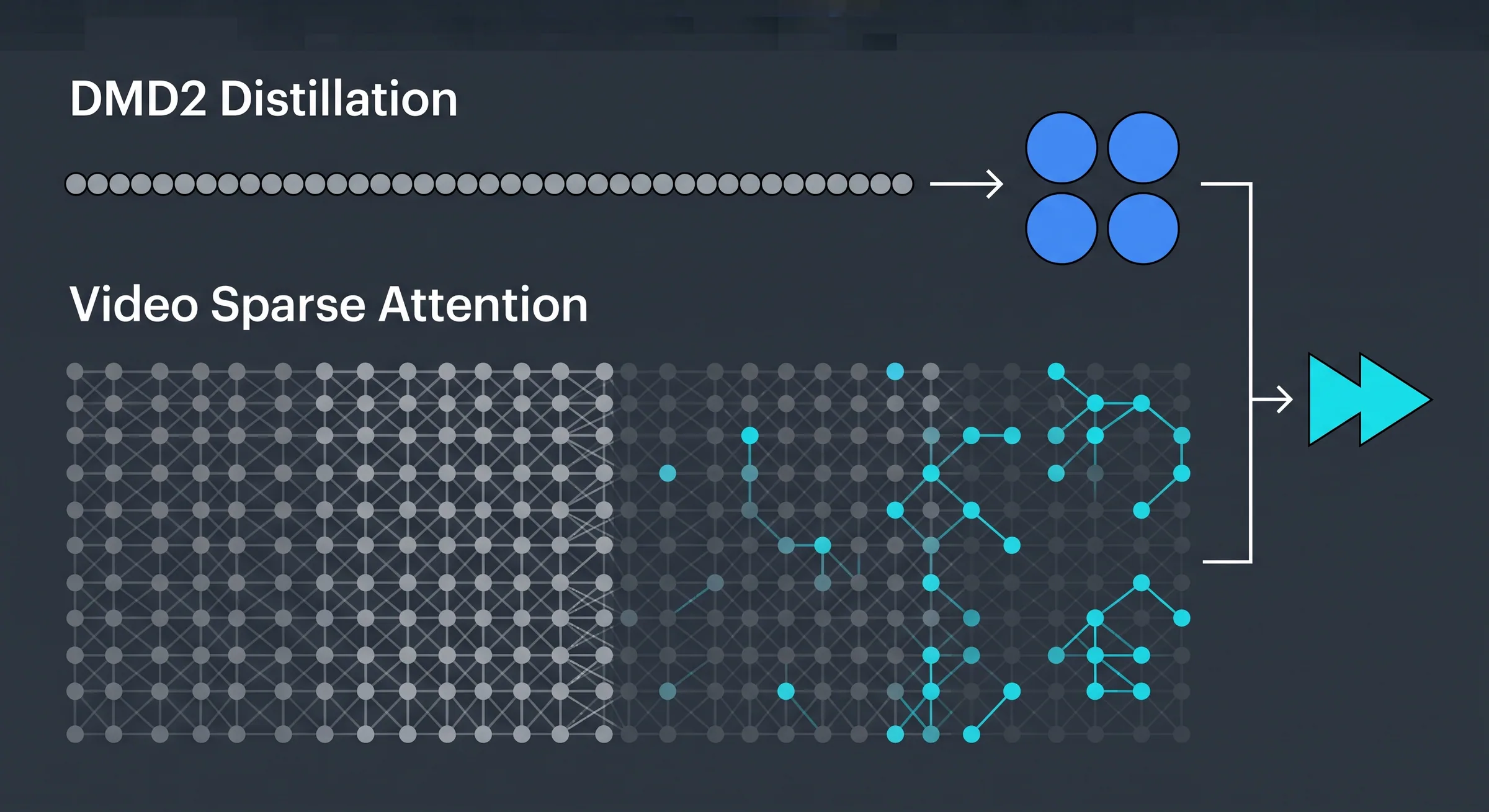
Here's what "data-free" means in Hao's FastH3 preview post, and it's a neat enough trick that it's worth slowing down for. Instead of feeding the student model a dataset of real clips, they took the full, uncompressed H3 and had it generate the training set itself, prompts in, videos out, then trained FastH3 to match that output distribution using DMD2 (Distribution Matching Distillation, version 2, out of a 2024 NeurIPS paper originally built for still images). The frozen original H3 acts as teacher, a learned critic scores how close the student's outputs are, and the student learns to reach roughly the same destination in four steps instead of 49. It's less "fine-tune on more data" and more "smaller model watches bigger model work, then compresses the habit," which is the same trick a lot of LLM distillation runs on. The upside nobody's saying out loud: this sidesteps every messy question about what MiniMax actually trained the original H3 on, because none of that data ever touches FastH3's training run.
The second lever is Video Sparse Attention, or VSA, and it's a more mundane kind of clever. Video diffusion transformers burn most of their compute on attention, every patch of every frame checked against every other patch, and a lot of that checking is redundant. VSA tiles the video into 64-token chunks and throws away roughly 90% of the video-to-video attention connections, while leaving text and audio attention untouched because those need the full context to keep prompts and dialogue on track. Stack that on top of DMD2's step reduction and you get multiplication instead of addition: fewer steps, and each step is cheaper too.
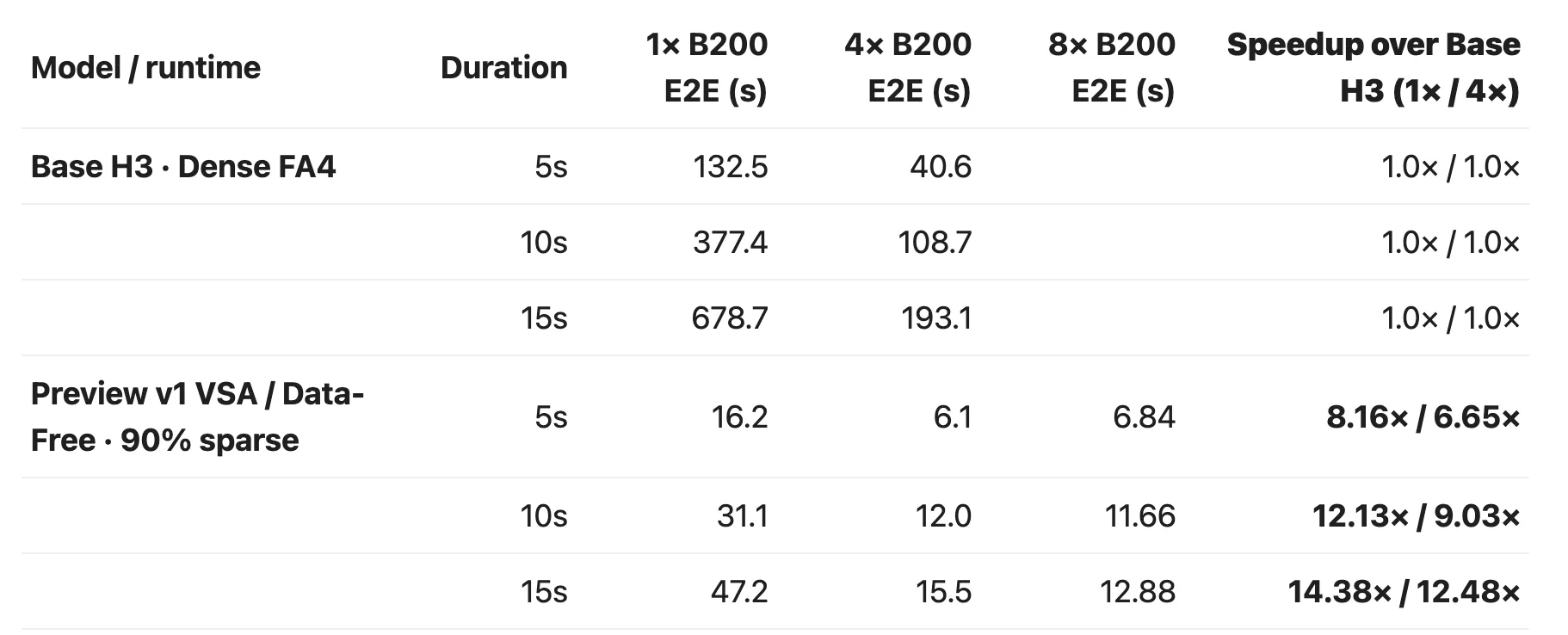
Now the number everyone's quoting. Hao's own benchmark table, run entirely on Nvidia B200 (Blackwell) GPUs, is worth reading as a curve, not a fact: a 5-second clip goes from dense-baseline slow to 16.2 seconds on a single B200, an 8.16x speedup. A 10-second clip hits 31.1 seconds on one B200 or 11.66 seconds spread across eight, 12.13x. The headline case, a 15-second 768p clip, drops to 47.2 seconds on one B200 or 12.88 seconds on eight, which is where "up to 14x" and "15 seconds of video in 13 seconds" both come from. Same data point, not two separate claims. Notice the shape of that curve: the multiplier climbs with clip length and GPU count, so "14x" is the best cell in the table, not the average one, and a single consumer card isn't in the table at all.
Clip length | FastH3 on 1x B200 | FastH3 on 8x B200 | Speedup vs. dense baseline |
|---|---|---|---|
5s | 16.2s | not tested | 8.16x |
10s | 31.1s | 11.66s | 12.13x |
15s (768p) | 47.2s | 12.88s | up to 14x |
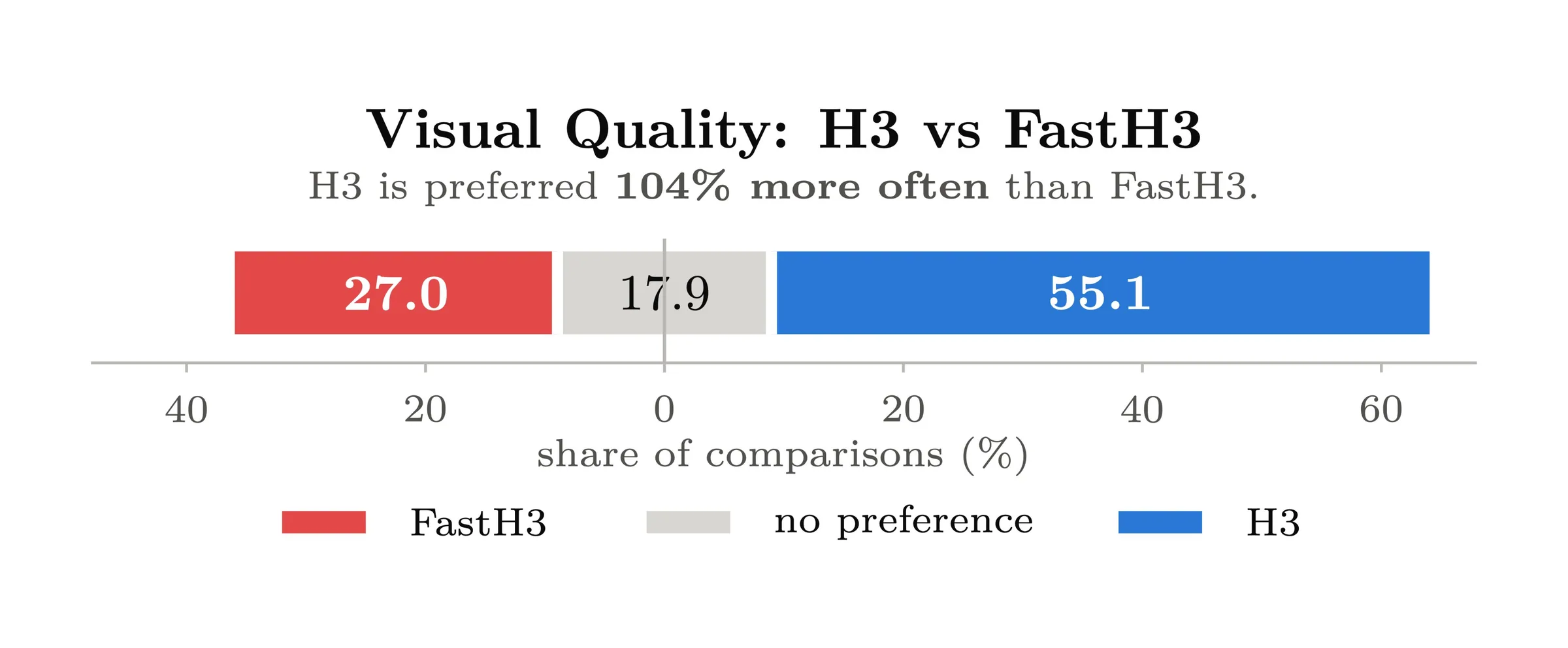
To their credit, Hao didn't just publish a speed number and walk away. They ran a blind perceptual eval with fal and researcher @isidentical, reporting FastH3 outputs were preferred or rated a tie against full-quality H3 in 45% of comparisons. That's a self-reported figure from the team that built the model, not an independent audit, so I'd treat it as "we checked and it didn't obviously fall apart" rather than "verified equivalent quality." Still, most distillation releases skip even that much, so it's worth crediting.
It's also not the only H3 speedup that shipped around the same time. Fal.ai released H3 Max, its own fine-tune of the same base model, claiming the better quality-to-latency tradeoff on its own chart. The difference that actually matters: H3 Max only exists behind fal's paid API, while FastH3 is fully open weights on top of an already-open model. If you want to inspect it, self-host it, or fine-tune it further, FastH3 is the one you can actually do that with.
Which gets to the question I actually care about: what happens on hardware a normal person owns. The B200 numbers are real but mostly theoretical for anyone not renting a cluster by the hour. The more useful data point is what the community's already measured. Kijai, the name you'll recognize if you've shrunk any video model down for ComfyUI before, shipped a roughly 22.9GB VSA checkpoint within days against the ~70GB full transformer, and early consumer-GPU reports are trickling in: an RTX 4090 generating a 5-second clip in 49 seconds, about 3.8x faster than a comparable 8-step workflow, and an RTX 4070 with 12GB of VRAM producing full-HD output in around five minutes. Neither of those is 14x. Both are real speedups you can go check yourself, which is worth more to me than a chart with B200 on the axis label.
Hardware | Output | Time | Speedup / note |
|---|---|---|---|
RTX 4090 | 5s clip | 49s | ~3.8x faster than a comparable 8-step workflow |
RTX 4070, 12GB VRAM | full-HD clip | ~5 minutes | no baseline reported |
Native ComfyUI support is also still in progress, not shipped: ComfyUI Wiki's own writeup is upfront that this is "a FastVideo-stack release rather than a drop-in checkpoint," meaning it wants FastVideo's own VSA-H3 backend rather than standard ComfyUI attention nodes for now. If you see "FastH3 works in ComfyUI" somewhere, read that as "mostly, via a PR that hasn't landed yet."
One more thing that's easy to miss between a repo readme and an actual license PDF: MiniMax open-sourced H3 on August 3 under what it calls the MiniMax H3 Community License, and that license carves out the European Union, the United Kingdom, South Korea, and the United States entirely, on top of requiring prior written approval from MiniMax for any company clearing $20 million in annual revenue. Atlas Cloud's breakdown lays out the geography plainly, and it's not a footnote, it's four of the biggest markets for anyone who'd actually want to build on this. FastH3 is a derivative of those same weights, so it inherits the same restriction rather than loosening it. That's a strange thing to bury under a speed benchmark, but it's the detail that determines whether any of this is legally usable to a big chunk of the audience reading about it.
If you want to actually run it, both the recommended VSA/data-free checkpoint and the code live on Hao AI Lab's FastVideo GitHub and on Hugging Face, alongside a rank-64 LoRA if you'd rather patch it onto an existing H3 setup than swap the full weights. There's also an Apple Silicon path through MLX, plus a separate, smaller family of "FastMetal-QAD" models (1.3B/5B/14B) built specifically for Macs, worth knowing those are different, smaller models rather than FastH3 running on a laptop.
So where does that leave it. The engineering is legitimately good: a data-free distillation, teacher generates the training set, student compresses the behavior, stacked with a sparse-attention trick that cuts real compute rather than just trimming steps. That's a genuinely useful contribution in a field mostly made of closed APIs quoting their own benchmarks. But "14x" is one cell in a table that most people will never sit in, the quality claim is self-graded homework, and the license quietly excludes four of the biggest markets for exactly the builders who'd want to try this first. Check what a 4090 actually gets you before you get excited about a B200 cluster's numbers, and check the license map before you build a product on top of either.