
LLaDA-Image Isn't the Diffusion-Language-Model Trick It Sounds Like
Ant Group's LLaDA-Image borrows its name from a diffusion language model, but only half the pipeline actually works that way. Here's the part that's real and the part that's marketing.
The name is doing a lot of work. LLaDA is a genuinely interesting piece of research: a language model that generates text by unmasking chunks of a sentence in parallel instead of writing it left to right one token at a time, the exact opposite of how every GPT-shaped model on the market works. So when Inclusion AI, Ant Group's AI research arm, dropped a 6-billion-parameter image model called LLaDA-Image on September 4, 2026, the obvious read is "they took the diffusion-language-model trick and pointed it at pixels." That's not quite what happened, and the actual mechanism is more interesting than the name implies, in a "here's what's real and what's branding" way rather than a "this is fake" way.
Start with what LLaDA actually is, because the lineage matters here. LLaDA, short for Large Language Diffusion with mAsking, came out of Renmin University's Gaoling School of AI in February 2025 as a paper arguing that autoregressive generation (predict the next token, then the next, then the next) isn't the only way to build a competent language model. LLaDA instead trains a Transformer to reverse a masking process: start from a sentence that's mostly blanked-out tokens and iteratively fill it in, several tokens at a time, in whatever order the model finds easiest. It's still a Transformer under the hood, but the generation process is discrete masked diffusion, not next-token prediction. Ant Group's Inclusion AI team picked the idea up and scaled it hard, shipping LLaDA2.0 up to a 100-billion-parameter mixture-of-experts diffusion language model and a smaller LLaDA2.0-mini (16B total, 1.4B active) that's genuinely used in production-adjacent tooling now, not just a research demo.
So LLaDA-Image inherits a real diffusion language model, LLaDA2.0-mini, as one of its two major components. That model, paired with a SigLIP-VQ vision encoder, sits frozen inside the pipeline and does the actual "reading": it processes your text prompt and any reference image and turns them into semantic conditioning. That part earns the name honestly, it's a dLLM doing masked-diffusion-style understanding. But the part that actually paints pixels is a separate, freshly-trained 6B single-stream Diffusion Transformer running continuous flow-matching, the same broad family of math that powers Stable Diffusion 3, FLUX, and Qwen-Image. Every block in that DiT jointly attends over the frozen model's semantic conditioning and the evolving image latents at once, but it isn't unmasking discrete image tokens the way LLaDA unmasks word tokens. Ant Group's own sibling project, LLaDA2.0-Uni, actually attempts that fuller version (it tokenizes images into a 16,384-word discrete vocabulary via SigLIP-VQ and runs genuine mask-token prediction on them before handing off to a separate decoder to reconstruct pixels). LLaDA-Image skips that step entirely for generation. The takeaway: half the "diffusion language model" claim is real and load-bearing, the other half is a continuous DiT wearing a name that suggests something more novel than it is.
None of that makes it a bad model. It arguably makes it a smarter design choice than trying to force masked token diffusion all the way down to pixels, which is still an unsolved problem nobody's shipped well yet. What Inclusion AI actually built is a well-engineered, fully open recipe: a from-scratch 6B DiT conditioned by a frozen, already-capable understanding model, trained on 220 million samples where 98% are real photographs (not synthetic data laundered through another model), with an image-only pretraining phase specifically meant to build visual priors before the model ever sees a caption. They also swapped in parameter-free RMSNorm across the DiT and the Muon optimizer for training stability, the kind of unglamorous infrastructure detail that papers usually bury in an appendix but that determines whether a 6B model actually converges cleanly at this scale.
Two speeds, same checkpoint architecture
LLaDA-Image ships in two variants that share the same base architecture but not the same step count. The base model needs 50 sampling steps with a guidance scale of 5.0, standard territory for a DiT this size. LLaDA-Image-Turbo gets there in 2 to 4 steps at a guidance scale of 1.0 (no classifier-free guidance overhead), using a distillation method Inclusion AI calls TwinFlow, which combines distribution-matching distillation with what they describe as self-adversarial flow training. That's the same broad family of technique (distribution-matching distillation, or DMD) that Bria used to compress its own Fibo 1.5 [check_internal_link] from 50 steps down to 4 to 6, which says something about where the field has converged on "how do you make a big diffusion transformer fast" this year: not a smaller model, a distilled one.
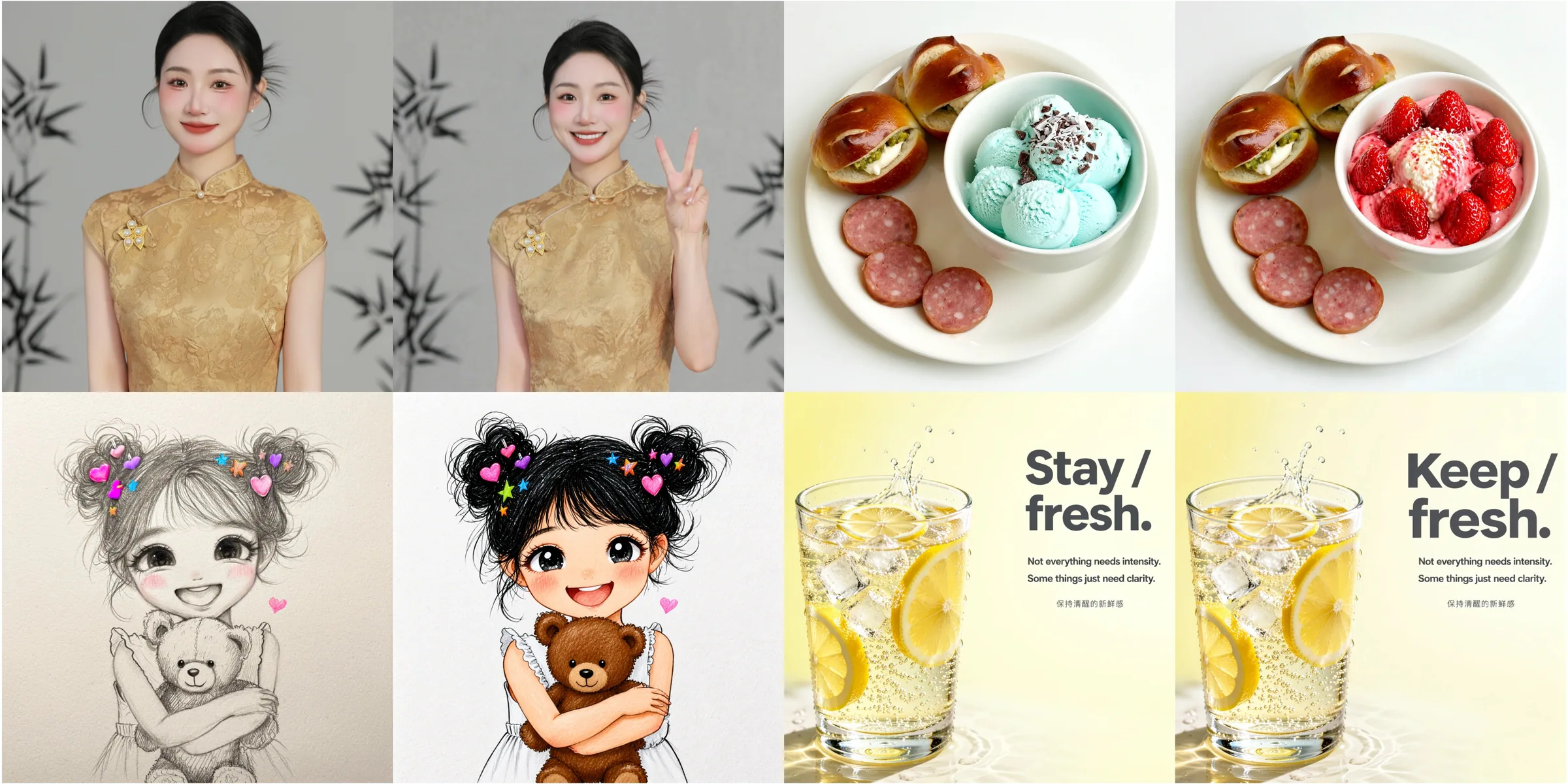
Here's where the two step counts stop being just a speed knob. Both variants are the exact same checkpoint architecture doing text-to-image generation, VQ-conditioned generation, and instruction-guided editing, which is a real unification most competing "unified" image models fake by bolting a separate editing head onto a generation backbone. For editing, LLaDA-Image bypasses the frozen understanding model entirely and injects a reference image through two parallel pathways at once: semantic features from the same SigLIP-VQ encoder, and raw latents from a FLUX.2 VAE. That dual-pathway trick is the actual mechanism behind Inclusion AI's "faithful content preservation" claim, giving the model both a semantic sense of what's in the reference image and a literal pixel-level anchor to hold onto while it makes the requested change.
The benchmark claim, and what it's actually scoped to
Inclusion AI's headline number is 53.53 on the English track and 53.38 on the Chinese track of Qwen-Image-Bench, a newer, harder evaluation that scores models across quality, aesthetics, prompt alignment, real-world fidelity, and creative generation rather than a single pass/fail check. The claim is "state-of-the-art among open-source models," and based on the benchmark's own published leaderboard, that framing holds up, but it's worth seeing next to the models it's explicitly not claiming to beat:
Model | Status | Qwen-Image-Bench overall |
|---|---|---|
GPT Image 2 | Closed | 64.69 |
Nano Banana 2.0 | Closed | 59.82 |
GPT Image 1.5 | Closed | 59.65 |
Nano Banana Pro | Closed | 59.45 |
Qwen Image 2.0 Pro | Closed | 57.84 |
LLaDA-Image | Open (Apache 2.0) | 53.53 (EN) / 53.38 (CN) |
That's an 11-point gap to the top closed model, so "SOTA among open-source models" is an accurate claim and a meaningfully narrower one than the headline number alone suggests. It's the same shape of caveat that shows up whenever a lab reports a benchmark it chose to lead with: true, and scoped exactly as far as it needs to be to sound impressive. On GenEval, Inclusion AI reports a perfect score for single-object generation and competitive attribute-binding scores, with an acknowledged weak spot in precisely counting large groups of objects, which tracks with a known failure mode across basically every diffusion image model, not something specific to LLaDA-Image.

Steps, and what that means for actually running it
Step count is the number that determines whether you're waiting five seconds or fifty for a generation, and it's a more useful cross-model comparison than any single benchmark score, since it's not something a lab can spin. Here's where LLaDA-Image's two variants land next to the other few-step and full-step image models currently in circulation:
Model | Sampling steps | Guidance | Notes |
|---|---|---|---|
LLaDA-Image (base) | 50 | CFG 5.0 | Same checkpoint handles generation and editing |
LLaDA-Image-Turbo | 2 to 4 | None (CFG 1.0) | TwinFlow distillation of the base checkpoint |
Qwen-Image | 50 (default) | true_cfg_scale applies | Full DiT, no distilled fast path in the base release |
FLUX.1-dev | 50 | Guidance-distilled | Still needs the full step count despite distillation on the guidance term |
FLUX.1-schnell | 1 to 4 | None | Distilled via latent adversarial diffusion distillation |
Original Bria FIBO (Nov 2025) | 50 | Required | JSON-native, no distillation |
Bria Fibo 1.5 (Aug 2026) | 4 to 6 | None | Distribution-matching distillation plus a DMD-R cleanup pass |
Read across that table and the real story isn't LLaDA-Image specifically, it's that basically every serious open image lab shipped a distilled few-step sibling to its flagship model within the same year. Turbo variants aren't a nice-to-have anymore, they're table stakes, and TwinFlow lands LLaDA-Image-Turbo at the aggressive end of that pack, tied with FLUX.1-schnell for the lowest step count on the list.
What's actually available, and who's touched it so far
This is the part that's easy to undersell: both checkpoints ship under Apache 2.0, in BF16 and FP8 on both Hugging Face and ModelScope, with inference code included in the GitHub repo now (training code is marked "coming soon"). Apache 2.0 with no commercial carve-out is a genuinely different deal than Bria's approach with Fibo 1.5, which is free for non-commercial use under CC BY-NC 4.0 but requires contacting Bria directly for a commercial license. If you want to fine-tune this thing and ship it inside a product tomorrow without an email to legal, LLaDA-Image is the more straightforward option of the two, even though Fibo 1.5's structured JSON control is the more sophisticated editing interface.
Independent reaction is thin right now, and I'd rather say that plainly than pad it out. The release is two days old as I'm writing this. A ComfyUI feature request went up the same day asking for node support, which is the standard early-adoption signal for any new open image model worth integrating locally, and an unaffiliated developer already spun up a public Turbo demo Space on Hugging Face within days rather than waiting for Inclusion AI to host one. The paper's Hugging Face discussion picked up meaningful community attention fast. What's missing so far is anyone outside Inclusion AI running their own head-to-head against Qwen-Image or FLUX on a prompt set the lab didn't pick, which is the only test that actually settles whether 53.53 survives contact with a stranger's prompts. Worth checking back on once someone runs that.