
Google's WeatherNext 3 Is Legit. Its Independent Referee Isn't Exactly Neutral.
WeatherNext 3 really does forecast rain more accurately than Google's last model. The leaderboard proving it is run by a company that sells weather forecasts too.
Every time you open Google Search and glance at the hourly rain forecast, there's now a decent chance the number came from a model that has never been peer-reviewed, evaluated against a leaderboard run by a company that also sells weather forecasts. That's not a knock on the science. It's just the part of the story Google's own announcement leaves out, and it's worth sitting with before getting to the genuinely impressive engineering underneath it.
The model is called WeatherNext 3, and Google DeepMind introduced it on September 3, 2026, alongside a same-day swap: WeatherNext 2, the version that had been quietly powering weather answers in Search, the Gemini app, and Google Maps, was replaced with WeatherNext 3 that day, for everyone, with no opt-in required. If you've asked Google what the weather's doing this week, you've probably already used it.
From graph neural networks to a live satellite feed
WeatherNext 3 isn't a clean-sheet model. It's the fourth generation of a lineage that's been reshaping how weather forecasting gets done since late 2023, and the lineage matters because each step changed the actual bet the model was making.
It started with GraphCast, a deterministic graph neural network published in Science in November 2023, which represented the atmosphere as a mesh of connected points and learned to predict how each one changes from its neighbors. It beat the European Centre for Medium-Range Weather Forecasting's flagship deterministic model, HRES, on more than 90% of the variables it was tested against, running in under a minute on a single TPU instead of hours on a supercomputer. Then came GenCast, a probabilistic diffusion model published in Nature in December 2024, which traded a single confident prediction for an ensemble of plausible futures, the approach every serious forecaster actually wants because weather is chaotic and a single number hides how uncertain you should be. GenCast beat ECMWF's ensemble system, ENS, on more than 97% of tested targets. Google later rebranded these two as WeatherNext Graph and WeatherNext Gen, the first generation of a unified product line.
WeatherNext 2 arrived in November 2025 with a genuinely different architecture, a Functional Generative Network that produces a full 64-member ensemble in a single forward pass instead of GenCast's iterative diffusion process, making it roughly eight times faster while beating its predecessor on 99.9% of variables and lead times. That FGN approach is also the backbone of WeatherNext 3, which is less a new architecture than a substantially scaled and re-plumbed version of it: the mesh transformer at its core grew from 24 layers to 32, its internal representation size grew from 768 to 1,024, and by one estimate from TechCrunch it now runs with roughly 2.4 times as many parameters as WeatherNext 2.
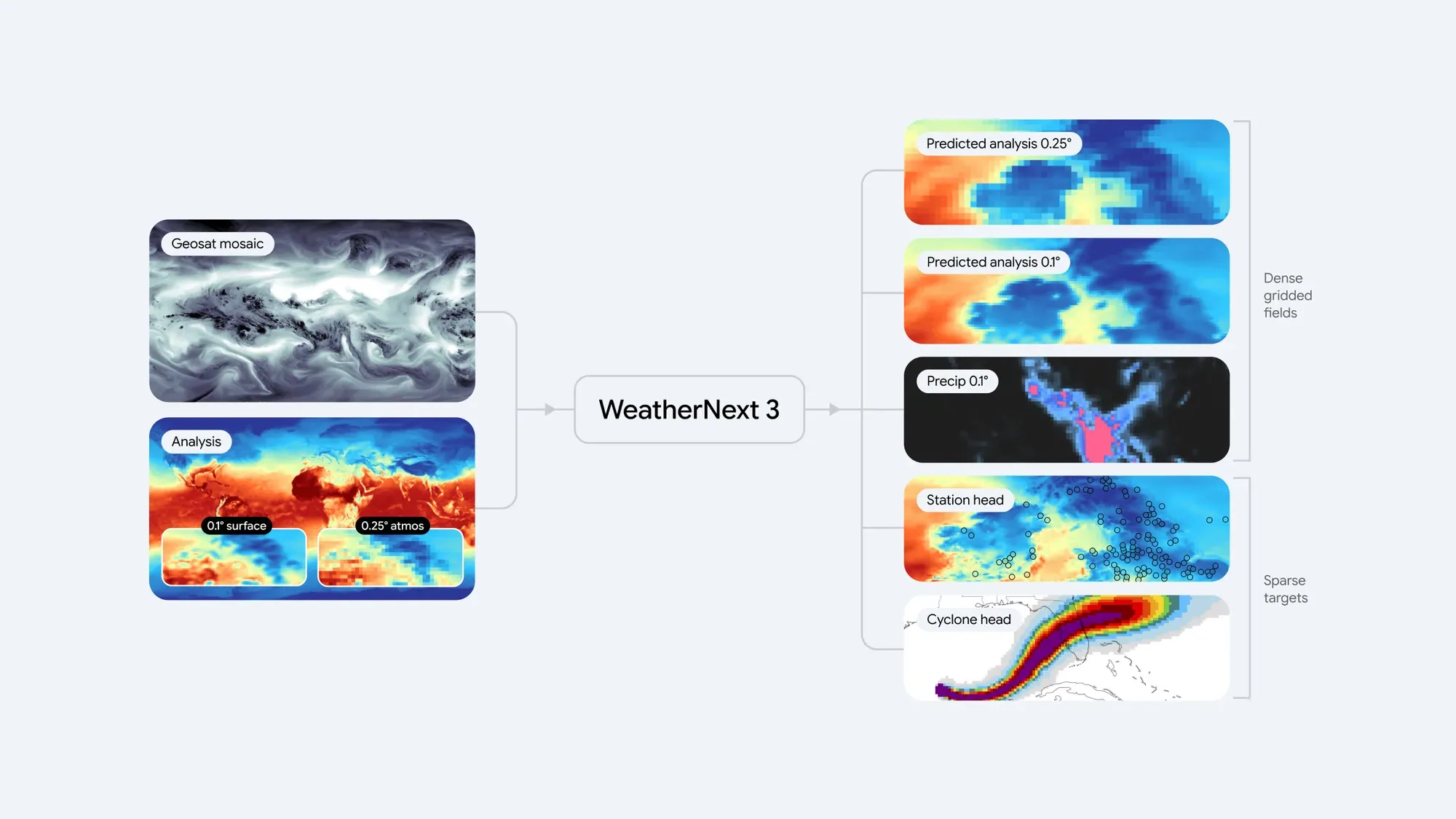
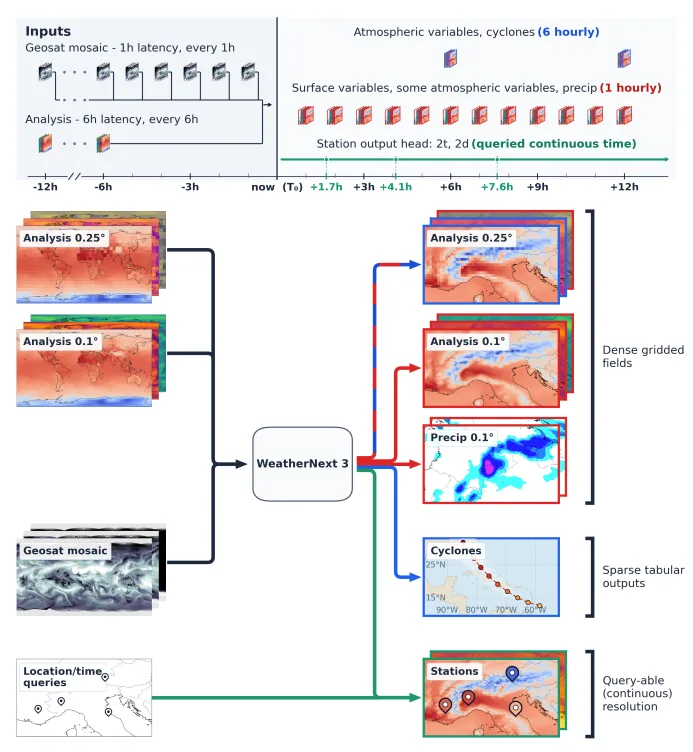
The more interesting change isn't size, though. Every model in this lineage, through WeatherNext 2, learned from the same kind of data traditional numerical weather prediction has always used: an "analysis," a reprocessed snapshot of the atmosphere's state that takes hours to assemble and only gets refreshed every six hours. WeatherNext 3 is trained to work directly from raw observations instead, most importantly a live mosaic stitched from geostationary weather satellites with roughly one-hour latency, plus a global network of surface stations (METAR airport sensors, Mesonet, ship and buoy reports going back to 2001) and NASA's IMERG satellite precipitation product. That's the actual engineering story: instead of waiting for someone else's six-hour-old analysis, the model watches the atmosphere update itself in close to real time and issues a fresh 15-day, 64-member ensemble forecast every single hour.
What "five times sharper" actually means
Google's blog post states the comparison plainly, if you read past the headline number: WeatherNext 3 provides "a global weather picture roughly five times sharper than our previous model, WeatherNext 2, which produced forecasts on a 25-kilometer grid in 6-hour increments." That's the whole claim. It is not a comparison to ECMWF, to physics-based numerical weather prediction generally, or to any other AI model. It's WeatherNext 3 against its immediate predecessor, on resolution and update frequency specifically, and on that narrow claim it checks out.
WeatherNext 2 | WeatherNext 3 | |
|---|---|---|
Surface variables (temperature, moisture) | 25 km grid | 5 km grid |
Other surface variables | 25 km grid | 10 km grid |
Atmospheric/pressure-level variables (wind) | 25 km grid | 25 km grid |
Forecast update frequency | Every 6 hours | Every hour |
Ensemble size | 64 members | 64 members |
Forecast horizon | 15 days | 15 days (hourly detail out to 48 hours) |
Primary training input | Reanalysis / NWP-style analysis | Live satellite mosaic + analysis + station data |
Source: WeatherNext 3 paper and Google's announcement.
Where the model does get measured against outside baselines, the results are genuinely strong, particularly for precipitation, historically one of the weakest spots for every AI weather model, including GraphCast. Google reports "up to 50% more accurate precipitation forecasts" for lead times of a day or more, and the paper's own scorecards back that up with harder numbers.
Reference dataset compared against | CRPS improvement (early lead times) |
|---|---|
NASA IMERG (satellite-derived precipitation) | Up to 60% |
MRMS (US radar-based precipitation) | 30% |
Rain gauge station observations | 10% |
Metric | vs. WeatherNext 2 | vs. ECMWF's ENS ensemble |
|---|---|---|
2-meter temperature (CRPS, short lead times, held-out stations) | Up to 30% better | Up to 40% better |
2-meter relative humidity (CRPS, short lead times) | -- | Roughly 40% better |
Source for both tables: arXiv:2609.03582, tested on weather stations excluded from training to check the model generalizes rather than memorizes.
That last point matters more than it sounds. Testing against stations the model never saw during training is exactly the kind of check that separates a real result from an inflated one, and CRPS (continuous ranked probability score, the standard way meteorologists grade a probabilistic forecast against what actually happened) rewards both accuracy and honest uncertainty, not just a lucky guess. In a real-time evaluation Google ran from July 1 to August 11, 2026, comparing live WeatherNext 3 output against ECMWF's own newest AI-assisted system, AIFS ENS v2, WeatherNext 3 came out ahead on most upper-atmosphere variables by roughly 10%, along with steadier improvements in tropical cyclone track and intensity. Google is not hiding its model's rough edges, either. The paper documents visible hexagonal artifacts in some individual forecast samples, a warm-or-cold bias in the station-level outputs, degraded performance at exactly the 6-hour mark for a subset of variables (though Google notes the model is never actually run at that interval operationally, so it's mostly academic), and a cyclone wind-direction output that performed so poorly it was pulled from operational use entirely. That's an unusually candid limitations section for a company announcement, and it's part of why the core numbers read as credible rather than cherry-picked.
The scoreboard's owner also plays the game
Here's the part that deserves more scrutiny than it's gotten in the coverage so far. None of the numbers above have been through peer review. GraphCast went through Science's review process. GenCast went through Nature's. WeatherNext 2 and WeatherNext 3 have not, at least not yet; both exist only as arXiv preprints and companion blog posts, reviewed internally at Google and nowhere else. That's a real change in the amount of external scrutiny this lineage has had, right at the point where the claims have gotten bigger.
The closest thing to independent validation is Operational WeatherBench, a live leaderboard that scores AI and physics-based forecast models daily against the same standard metrics, where WeatherNext 3 currently ranks first. Google and multiple outlets covering the launch, including Gizmodo, point to that ranking as the outside confirmation the self-reported numbers need. It's worth knowing who runs it. Operational WeatherBench is built by Brightband, a startup co-founded by Ryan Keisler, Amy McGovern, Daniel Rothenberg, and Julian Green, whose actual business is selling AI-generated weather and climate forecasts to governments and enterprises. Brightband isn't a neutral academic lab keeping score from the sidelines; it's a company competing in the same market WeatherNext 3 just got dropped into, running the scoreboard both it and Google get measured on. Rothenberg, one of its co-founders, was quoted by TechCrunch praising WeatherNext 3's move toward station-level, real-world targeting as bringing forecasting "closer to the core" of what's actually useful, which is a genuinely fair technical point and also the kind of thing a competitor with something to gain from a credible-referee reputation would say either way. None of that means the leaderboard's methodology is rigged. It does mean "independent" is doing more work in that sentence than it should, and a reader deserves to know the referee has skin in the game.
The other wrinkle TechCrunch surfaced: Google isn't actually first to train on raw observations. WindBorne, another AI weather startup, says its WeatherMesh 6 model has been assimilating raw weather-balloon data since late 2025, months before WeatherNext 3 shipped. Google's response, per that reporting, was that WeatherNext 3 still offers higher resolution globally, which may well be true, but it undercuts the idea that "trains directly on raw observations" is a Google-only breakthrough rather than an idea multiple labs converged on around the same time.
Where a normal user actually encounters it
The consumer-facing claim in Google's announcement is the most concrete part of the whole release: WeatherNext 3 forecasts are already live in Search, the Gemini app, and Google Maps as of launch day, quietly swapped in for WeatherNext 2 with no announcement banner or setting to toggle. If you're checking the hourly forecast in any of those surfaces today, you're already looking at WeatherNext 3 output, whether or not you knew the model's name.
Beyond that, access splits along familiar lines. Anyone curious can poke around Weather Lab, Google's public visualization site, which shows WeatherNext 3's global forecasts alongside its cyclone-tracking predictions plotted against real tropical storms as they happen, explicitly labeled experimental research output rather than an official warning system. Developers and researchers can pull the raw forecast data through BigQuery, Google Earth Engine, or bulk download from Cloud Storage. Enterprises get it through the Google Maps Platform Weather API and Vertex AI, the tier actually generating revenue, aimed at things like energy traders who want 100-meter wind speed and solar radiation forecasts for grid planning, and at humanitarian and public-sector users in Latin America, Africa, and Asia-Pacific, regions Google specifically calls out as historically underserved by supercomputer-dependent physics models. None of this is a replacement for your national weather service's severe-weather warnings, and Google says as much directly, describing WeatherNext as "an automated, experimental AI system" that shouldn't substitute for official alerts.
This isn't the first time Google's research arm has tried to package planetary-scale prediction into something outsiders can actually use. Its Planetary Prediction Engine [check_internal_link], announced just a week earlier, takes a similar bet, that the hard part isn't the underlying model but the plumbing around it, though it's aimed at a different problem entirely: turning a plain-English question into a trained geospatial model for things like food-insecurity mapping or disease-outbreak forecasting, not predicting the atmosphere itself. The two sit under the same Earth AI umbrella at Google, and both lean on components, like the AlphaEarth satellite embeddings, that were built once and reused across projects. Whether the underlying atmosphere-modeling engine wins broad scientific trust the way GraphCast and GenCast did will depend on something Google can't provide by itself: a peer-reviewed publication, and a scoreboard nobody has a stake in.