

The Training Trick That's Cutting AI Image Generator Costs by Up to 63%
ByteDance Seed's DiffusionOPSD swaps one vague final-image score for precise per-step training targets, and the GPU savings are the real headline.
Picture a writing teacher who only ever hands back a letter grade. No margin notes, no circled sentences, just a C+ on the last page. The student knows something in the essay didn't work, but not what: the thesis, paragraph three, the ending, all equally suspect. Now picture a teacher who instead circles the actual weak sentence and writes a sharper version next to it. Same subject, same grading standard, wildly more useful feedback.
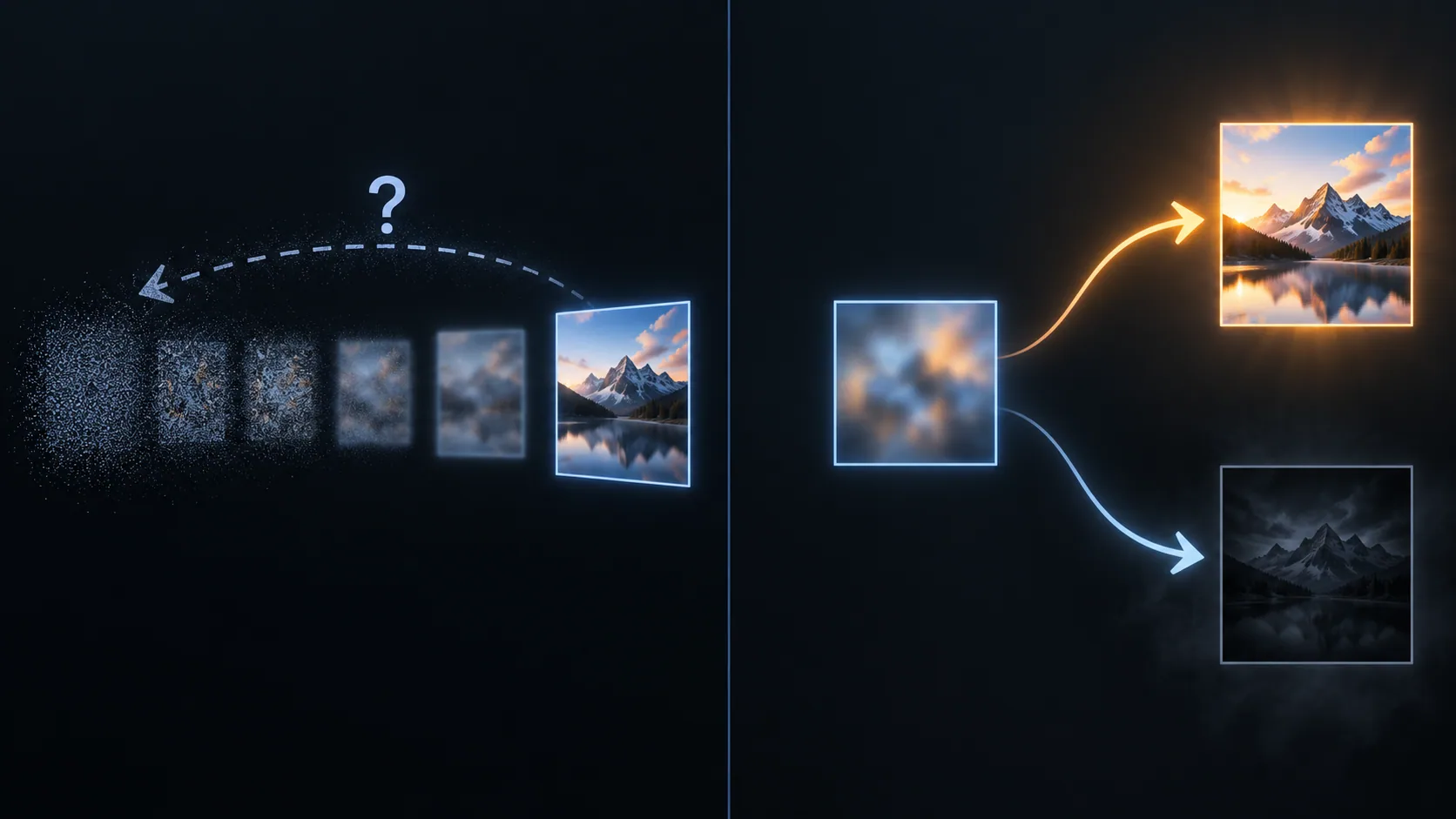
That gap is basically what a team at ByteDance Seed, the company's foundation-model research group, just closed for a different kind of student. Diffusion models, the family of neural networks behind most modern AI image generators, learn to paint a picture by starting from pure noise and cleaning it up over roughly twenty small steps. For the last few years, the standard way to make one of these models produce images people actually like has worked exactly like the blind-grading teacher: run the full twenty-step process, show the finished image to a reward model (a separate network trained to mimic human taste, sharpness, or prompt-following judgments), get back one number, and try to spread that single number's worth of credit or blame back across every step that led to it. Methods like ReFL and DiffusionNFT do this reasonably well. But the model never learns which specific step produced the garbled hand or the missing word in the prompt, only that something, somewhere in twenty steps, was off.
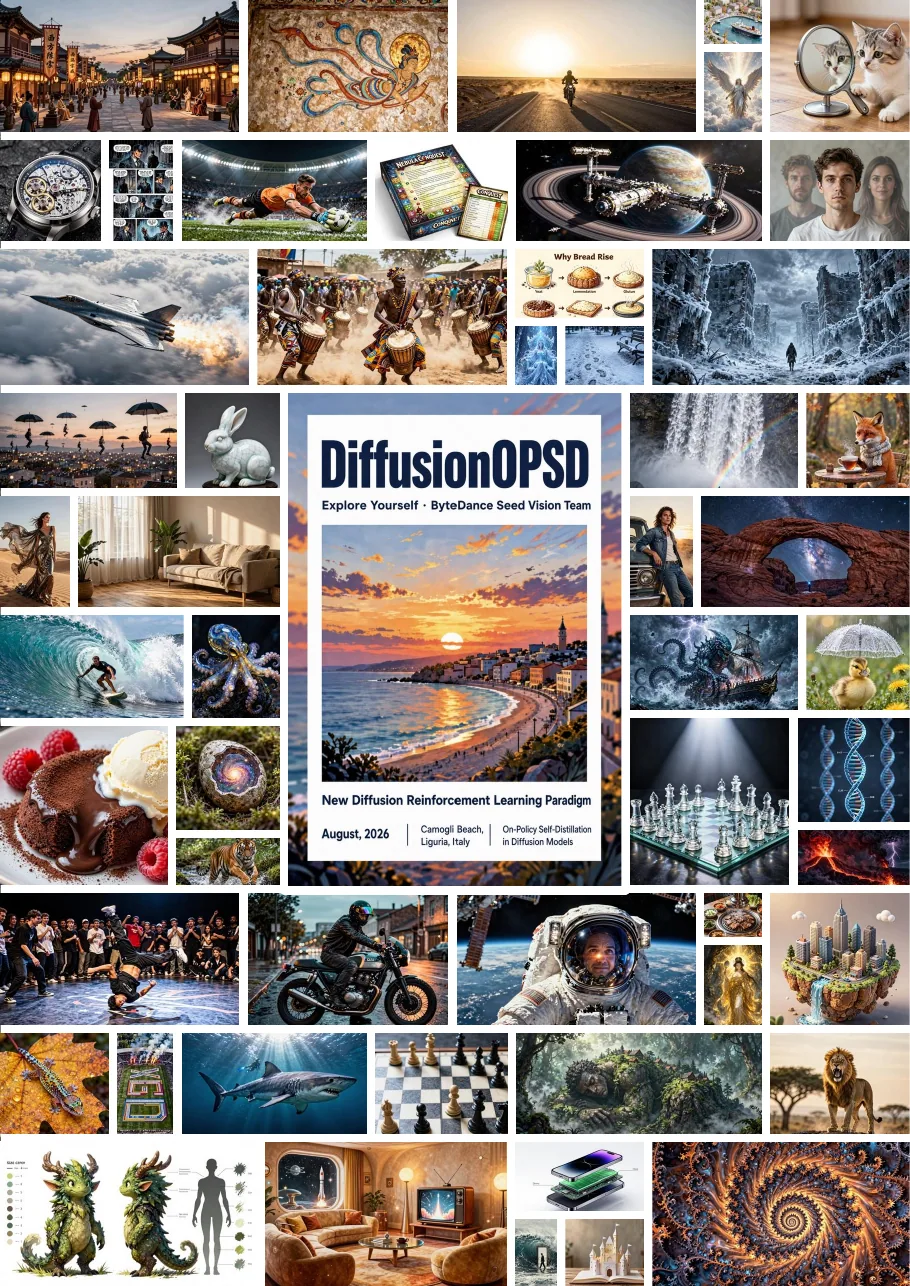
What actually changed
DiffusionOPSD, short for "On-Policy Self-Distillation," is ByteDance Seed's fix for that blind spot, laid out in a paper posted August 25 as arXiv 2608.24646. It's led by researchers Wei Zhou and Xiongwei Zhu, with a co-author list that reads like a university consortium: the National University of Singapore, UC San Diego, University of Maryland, both HKUST campuses, Duke, UC Berkeley, and Oxford all appear in the affiliations. I'd normally treat a lab's self-reported training numbers with real suspicion, and I still do here (more on that shortly), but a paper with this many outside co-authors has more people who'd have caught an obviously cooked number before it went out.
The mechanism itself is the interesting part, and it's not complicated once you see the essay analogy underneath it. At some randomly chosen point partway through the twenty-step denoising process, the model already has a rough draft: a "clean-output anchor," in the paper's terms, meaning its current best guess at what the finished image will look like if it kept going from here. DiffusionOPSD takes that rough draft and nudges it twice, in a small, bounded way (a "trust region," so the nudge stays realistic rather than drifting into a nonsense image): once toward higher reward, once toward lower reward. Those two nudged versions become the circled sentence and the rewrite suggestion. The model is then trained to move its own prediction toward the better version and away from the worse one, using what the paper calls a self-distillation loss, meaning the two targets are treated as fixed and the gradient only flows back through the model's own next guess, not through the reward model itself. Every training step gets an explicit "closer to this, farther from that," instead of one blurry number that has to be spread thin across twenty steps of blame.
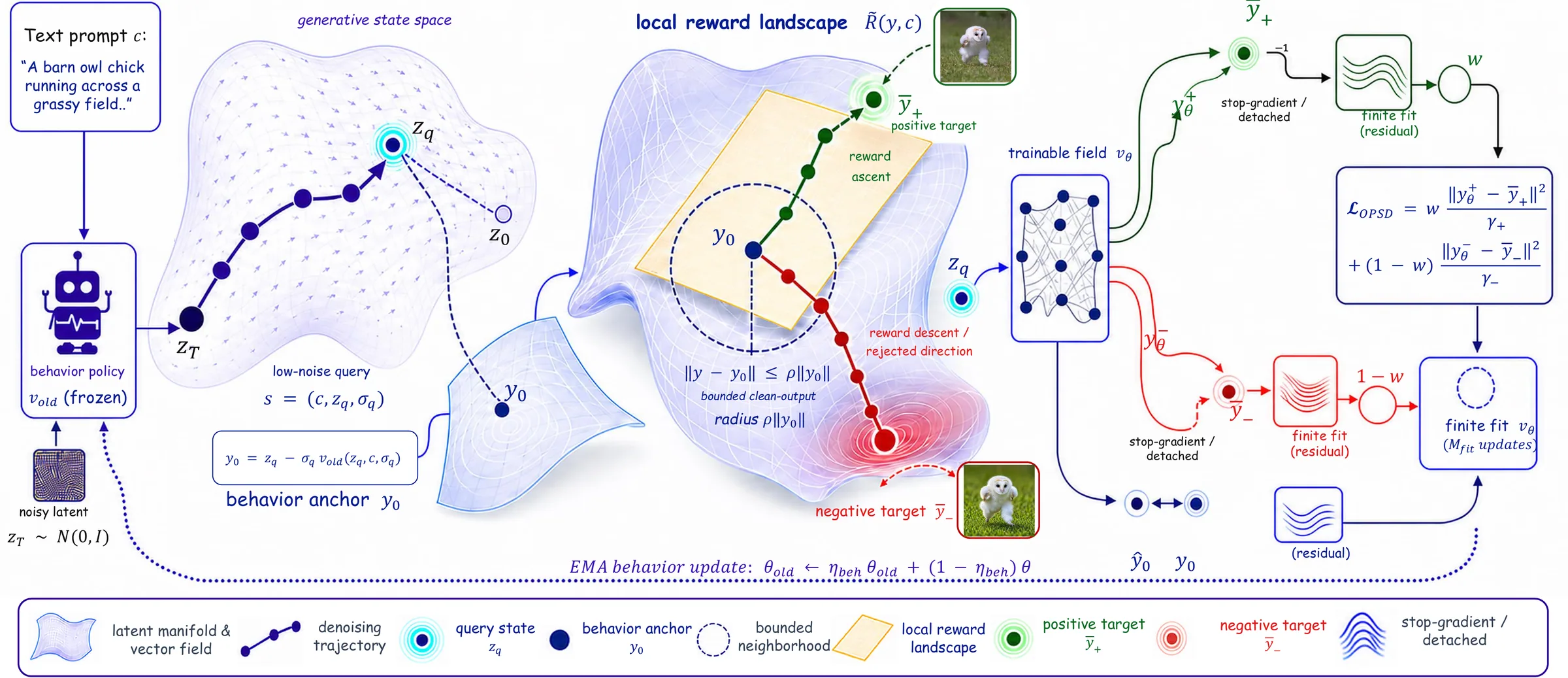
There's a second piece worth understanding, because it's what keeps the whole scheme honest: a frozen "behavior policy" is the one that actually goes out and collects the training examples, and it gets periodically refreshed with an exponential moving average pulled from the model currently being trained. Without that, the targets could drift toward states the model would never realistically land in on its own, and the model would end up training against a fantasy version of itself instead of the one it actually is.
What the numbers actually show
I default to skeptical on any lab's self-reported training-efficiency claim, because the comparison is almost always run on the reporting lab's own hardware, against a baseline the same lab chose. That skepticism is warranted here too, just not fatal. The efficiency claim, stripped of marketing gloss, is specifically a comparison against DiffusionNFT, the strongest and most directly comparable baseline in the paper, not against fine-tuning methods generally. On Stable Diffusion 3.5-Medium, ByteDance's own published table shows DiffusionOPSD needing 126.9 GPU-seconds per training update against DiffusionNFT's 212.4, a 40% reduction for the same number of updates. On Alibaba's Z-Image-Turbo, the gap widens considerably: 674.0 seconds per update against DiffusionNFT's 1,826.2, a 63% reduction. Those are real, specific, checkable numbers from the paper's own tables, which is more than a lot of efficiency claims in this space get.
Backbone | DiffusionNFT (GPU-sec/update) | DiffusionOPSD (GPU-sec/update) | Reduction |
|---|---|---|---|
Stable Diffusion 3.5-Medium | 212.4 | 126.9 | 40% |
Z-Image-Turbo | 1,826.2 | 674.0 | 63% |
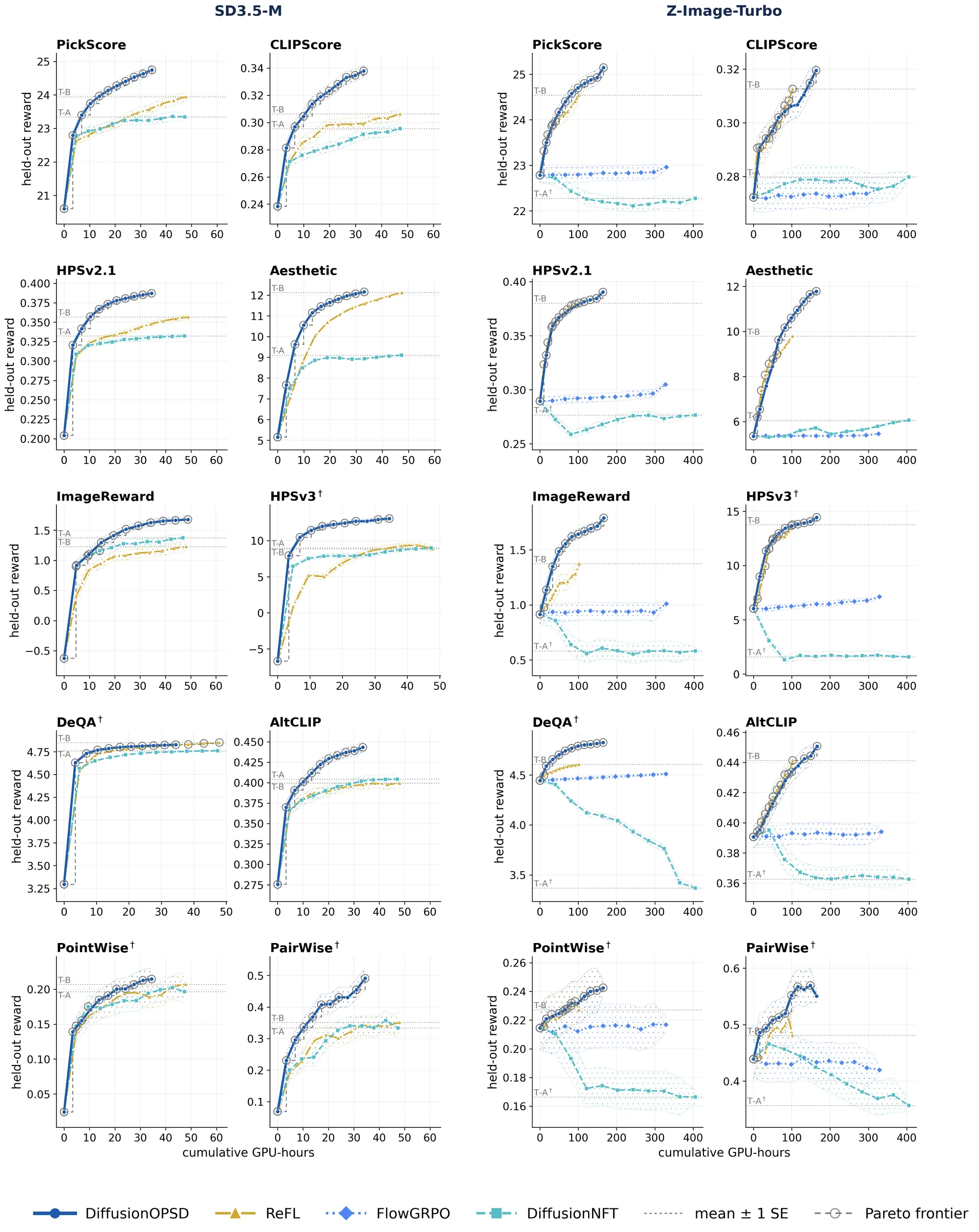
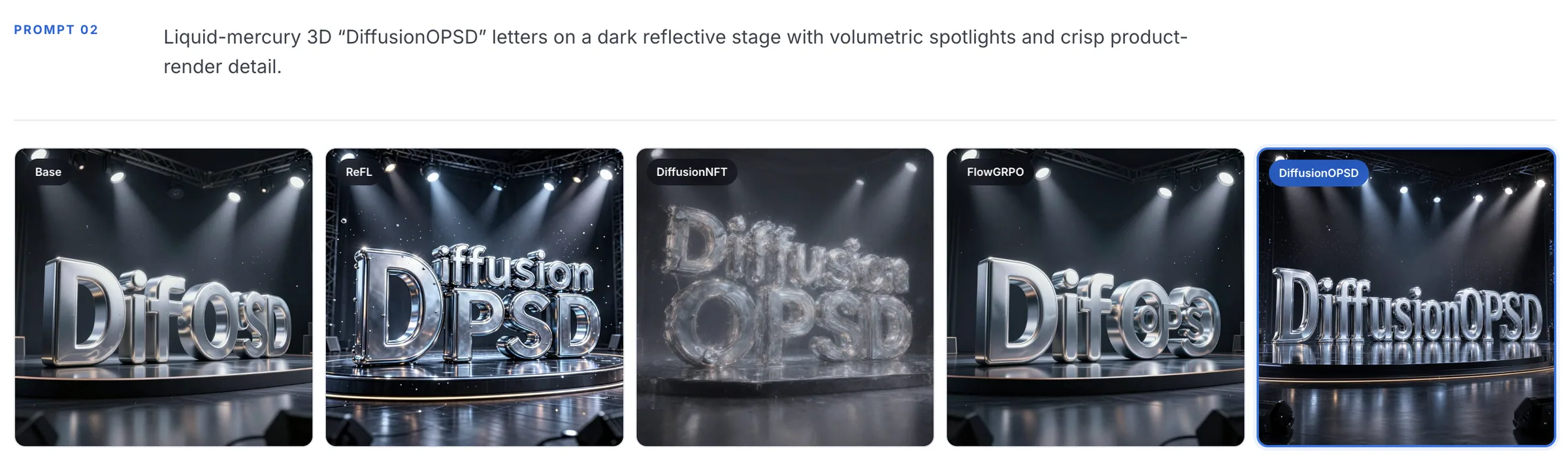
On quality, the paper reports the best held-out score in 19 of 20 reward-matched settings across its two model backbones and ten separate evaluators, among them PickScore, CLIPScore, HPSv2.1, an aesthetic scorer, ImageReward, HPSv3, DeQA, and AltCLIP, plus two win-rate metrics it labels Point and Pair. Nineteen of twenty is a genuinely strong sweep. It's also, notably, not twenty of twenty, though the project's own landing page rounds up to "20/20" in a couple of spots while the paper text and the GitHub README both say 19. That's a small thing to catch, but it's exactly the kind of rounding worth flagging on principle, because a paper that's comfortable inflating a clean number in its own marketing copy is a paper whose other numbers deserve a second look too. On the SD3.5-M backbone specifically, DiffusionOPSD scores 13.34 on HPSv3 against ReFL's 9.33 and DiffusionNFT's 9.14, and 24.94 on PickScore against ReFL's 23.92, consistent enough across evaluators that it doesn't read like a cherry-picked win.
Evaluator (SD3.5-M backbone) | ReFL | DiffusionNFT | DiffusionOPSD |
|---|---|---|---|
HPSv3 | 9.33 | 9.14 | 13.34 |
PickScore | 23.92 | not reported in the paper's own writeup | 24.94 |

Reward fine-tuning for diffusion models isn't a new idea; DiffusionOPSD is the latest entry in a lineage that goes back to 2023's DDPO, which treated the whole denoising process as a reinforcement-learning problem and optimized it step by step with PPO, and Diffusion-DPO, which imported the LLM world's direct-preference-optimization trick to skip the reward model entirely in favor of pairwise human preferences. ReFL made differentiable-reward fine-tuning practical by truncating the rollout and backpropagating through only the last few steps rather than all twenty. DiffusionOPSD isn't proposing a new reward model or a new preference dataset; it's a more surgical way of turning whatever reward signal you already have into a usable gradient, which is presumably why the paper picks DiffusionNFT and FlowGRPO as its comparison points rather than the older DDPO or DPO generation. The model-agnostic pitch also holds up on inspection: the method only needs a differentiable reward model and access to the intermediate denoising states, which describes essentially any modern diffusion or flow-matching image model, not something specific to SD3.5 or Z-Image.

Who this is actually for, and the fine print
Nobody reading this can download DiffusionOPSD and start generating images with it, because it isn't a model. It's a training recipe you apply on top of one, which the paper demonstrates on SD3.5-Medium and Z-Image-Turbo. If you're not training or fine-tuning diffusion models yourself, nothing about what you can generate today changes. What this looks like in practice, if it holds up, is showing up quietly a few months from now inside the next round of open and commercial image models, the same way ReFL and DPO-style tuning eventually did.
For anyone who is in that audience, the code lives at worldbench/DiffusionOPSD on GitHub under an Apache 2.0 license, with training launchers for both backbones, support for seven public reward models, and baseline launchers for DiffusionNFT, FlowGRPO, and ReFL so the paper's comparisons can be reproduced rather than taken on faith. It wants a CUDA Linux machine, Python 3.10 or 3.11, and, per the README's own figures, roughly 47.8 to 50 GB of peak VRAM per GPU for the SD3.5-M runs across an eight-GPU setup: multi-GPU cluster territory, not a hobbyist's laptop. Trained checkpoints are posted on Hugging Face under WeiChow/DiffusionOPSD.
One more caveat worth sitting with: that GitHub repo describes itself, in its own README, as "an external implementation of the algorithm" in the paper, not ByteDance's internal repository. It's built by people clearly inside the paper's own research orbit (the same GitHub org also hosts a related project called DanceOPD), and it ships the full training pipeline rather than a rough approximation, so I wouldn't discount it. But it's a reference implementation, not the exact code ByteDance runs internally, and anyone trying to reproduce the paper's numbers exactly should expect some drift. Combine that with the fact that the headline "44% better than the strongest competitor" figure is the best case pulled from the most favorable of ten evaluators rather than a typical margin, and the honest summary is: the method is well-motivated, the mechanism is genuinely clever, and the numbers are good but self-reported. Whether DiffusionOPSD matters beyond this one paper depends entirely on whether other labs pick it up, which is true of every training-efficiency claim until someone outside the original team runs it and gets the same answer.